Arrival and an Immediate Change of Plan
May 1981 found me aboard a C-141 bound for Turkey. Upon arrival on a hot, dusty evening, I was greeted by Master Sgt. Dave Byrd. Dave and I got to know each other earlier that year at the Defense Information School, where we attended the three-week Broadcast Manager Course designed to prepare officers and senior NCOs for management in the Armed Forces Radio and Television Service system.
I had made master sergeant on the last day of the previous promotion cycle. Dave, with his much longer period of service, had put on master sergeant as one of the first selectees in the new cycle. I outranked him by one month.
The plan was for me to serve as the station's number-two NCO and program director, while Dave would be the noncommissioned officer in charge of television. Upon arrival, however, we discovered a new wrinkle. The detachment chief and station manager, Senior Master Sgt. Mark Morris, had been selected for chief master sergeant and tapped for immediate transfer to a larger station at Lajes Field in the Azores.
That made me the top NCO, and I served as detachment chief for several months until Senior Master Sgt. John Rowley arrived from Zaragoza in late August or early September.
A Much Larger Operation
This was a much larger operation than I had been accustomed to in AFRTS. I think there were about thirty-three people altogether, with no civilian employees and four or five Army personnel.
I quickly moved into the leadership position and became acquainted with our base public affairs officer and NCOIC, Capt. Mary Ellen Jadek and Master Sgt. Tony Magaldi. I also began attending weekly staff meetings with the group commander, Col. Robert M. Thompson.
The Base and the Mission
The base had few permanent aircraft assigned. Most flying activity consisted of fighter aircraft rotating through for realistic training in that environment, primarily from units based at Torrejon, Spain. We relied on the constant flow of C-141s, the workhorse C-130s that resupplied more remote outposts in the country, and the occasional C-5.
Many of the base buildings were in a state of neglect. The AFRTS station occupied a semi-Quonset hut attached to what had been, or perhaps still was, the base theater.
One landmark was a small concrete building, painted green, where U-2 pilot Francis Gary Powers had prepared for his fateful mission over Russia. I do not think the building was in use anymore, but it remained a focal point near the flight line.
Also missing was the M*A*S*H-like atmosphere of my previous Sondrestrom assignment. Everyone worked with an understanding of the mission and our support for a war-fighting mission in the Middle East and that part of the world. We drilled regularly with our chemical-warfare protective equipment and gas masks, with possible Syrian missiles only about 12 to 14 minutes away.
Housing and a Decision About Family
Although I was expecting increased amenities now that I was a senior noncommissioned officer, base housing for both families and unaccompanied personnel was limited. Only a handful of master sergeants -- those with much more time in grade -- could reside in the single-occupant units. I was relegated to the common NCO and airman dormitories with a roommate. I concluded that I was not ready for "Menopause Manor" anyway.
It did not take long before I realized I had made the right decision not to bring the family. Unless they lived in a Turkish apartment off base, families were housed in 1953-model mobile homes attached to lean-to modular structures. They were cramped and, in my view, fire traps.
In fact, our electronic news-gathering crew had to stop its camera when President Reagan's ambassador to Turkey, Robert Strausz-Hupe, visited Incirlik and burst into tears when he saw the living conditions for American servicemen and their families.
Learning to Lead
I think the public affairs staff and I made a pretty good team. We were always on the same wavelength and coordinated closely. There were challenges in managing the overall workforce, however. With me in the temporary leadership position, for the first time in my life I had to deal with discipline problems - something that had been absent from my previous public affairs and broadcasting assignments.
Then there was the pesky electrical transformer outside the station manager's office, which regularly exploded and caught fire. The building was in an advanced state of disrepair, and maintenance was do-it-yourself. All of us pooled a few dollars each month to have a local Turkish man do most of the janitorial work. He had done it for years, and our monthly contribution became known as "Abie Dues."
Radio, Television, and the People Who Made It Work
Dave Byrd was great to work with, and for the most part I was blessed with a talented staff. The 6 and 10 p.m. television newscasts remained our most visible product, but radio was still king as a communication device and deserved equal attention.
We had an extensive list of country sensitivities to avoid in our on-air products and services. A compound of Turkish officers received our cable television, our over-the-air television, and our low-power radio signal.
My performance reports gave me glowing marks for radio and television operations, but working in the wing environment gave me the most rewarding feeling. John Rowley's arrival eased me back into greater involvement as program director for our radio and television operations, an assignment for which John gave me a glowing performance report.
I loved the prospect of developing talent on both radio and television. I was blessed with the combination of Tech. Sgt. Steve Hall and Sergeant Deborah Dollar in our electronic news-gathering operation, and I took it upon myself to mentor him and would later tap Steve for more responsibilities.
The glue that held everything together was our maintenance department - the engineers, as we called them - headed by the talented, knowledgeable, and ever-efficient Tech. Sgt. Steve White. We could not operate without them, but sometimes it was a struggle to get our “talent” to recognize them as essential. Our job was not to break equipment. We were all broadcasters: on-air talent, maintainers, administrative staff, and supply.
Because Incirlik was a high-visibility base, we were often visited by general officers. Unlike my earlier AFTV experiences, when the station manager insisted on hosting interviews with distinguished visitors, I insisted that our more junior noncommissioned officers handle the interviews.
I came to realize that my on-air days had come to an end, at least in the AFRTS system. I did, however, relish the opportunity to host the television newscasts on Christmas and New Year's Eve so that more junior people could have the holidays off. I remember signing off the news on Christmas Eve and then joining Chief Master Sergeant of the Air Force Bud Andrews at midnight Mass in the base chapel.
Golf and Dormitory Cooking
I pretty much adopted a six-day workweek, taking time for golf on Saturday and Sunday mornings.
We had a primitive nine-hole golf course, and the greens were built atop oil drums that had been covered with sand and turf. It was a fair test of golf. Senior Master Sgt. Jim Dworek became a regular golfing partner, and the two of us got to know the three-person staff at the course as regular customers.
Golf was the only relief activity I found during my year there, other than cooking in my dormitory room. The dining halls were staffed by Turkish employees and left much to be desired. Let us just say they would never have contended for a Hennessy Award. Many American favorites were either off the menu or prepared with substitutes unfamiliar to us. A small steakhouse operated by the base exchange was the only alternative, so I invested in a crockpot and a small toaster oven and began making weekly visits to the reasonably well-stocked base commissary.
I had learned basic cooking skills at Peterson Air Force Base while my wife was working on her baccalaureate degree. I found great relief, and maybe a little talent, in cooking and took pride in whipping up what I could in a make-do situation in the barracks.
Promotion and Departure
I was not really counting the days until the end of my short tour at Incirlik. I was never a “day counter” or gone “FIGMO.” I simply knew that the tour would end in May.
I received a request from Col. Thompson to be the narrator for his change-of-command ceremony. I had a good rapport with Col. Thompson. I had taken photos of his wedding reception, and he had given me a great letter of evaluation that I think put me over the top when the promotion board met.
On the day of the ceremony Col. Thompson pulled me aside and told me I had been selected for promotion to senior master sergeant. That kept my first time-eligible record intact. The ceremony was officiated by Lt. Gen. Robert W. Bazley, the vice commander of USAFE, and Col. Thompson was destined for even more responsibility.
I did not get a chance to thumb my nose at the residents of Menopause Manor; none had been selected. I joined John Rowley and Steve White for an interim stop at Ramstein Air Base, Germany. We collected hardware as the European detachment and station of the year, best maintenance team, and senior NCO of the year.
I was off to the schoolhouse. Broadcasting had again been challenging. We did not have satellite radio or television at any of my assignments, but the ground under, and space above broadcasters was shifting swiftly. I was committed to riding the crest of that wave of change.
FROM THE FILE · 9 FEBRUARY 1982
Recognition from TUSLOG
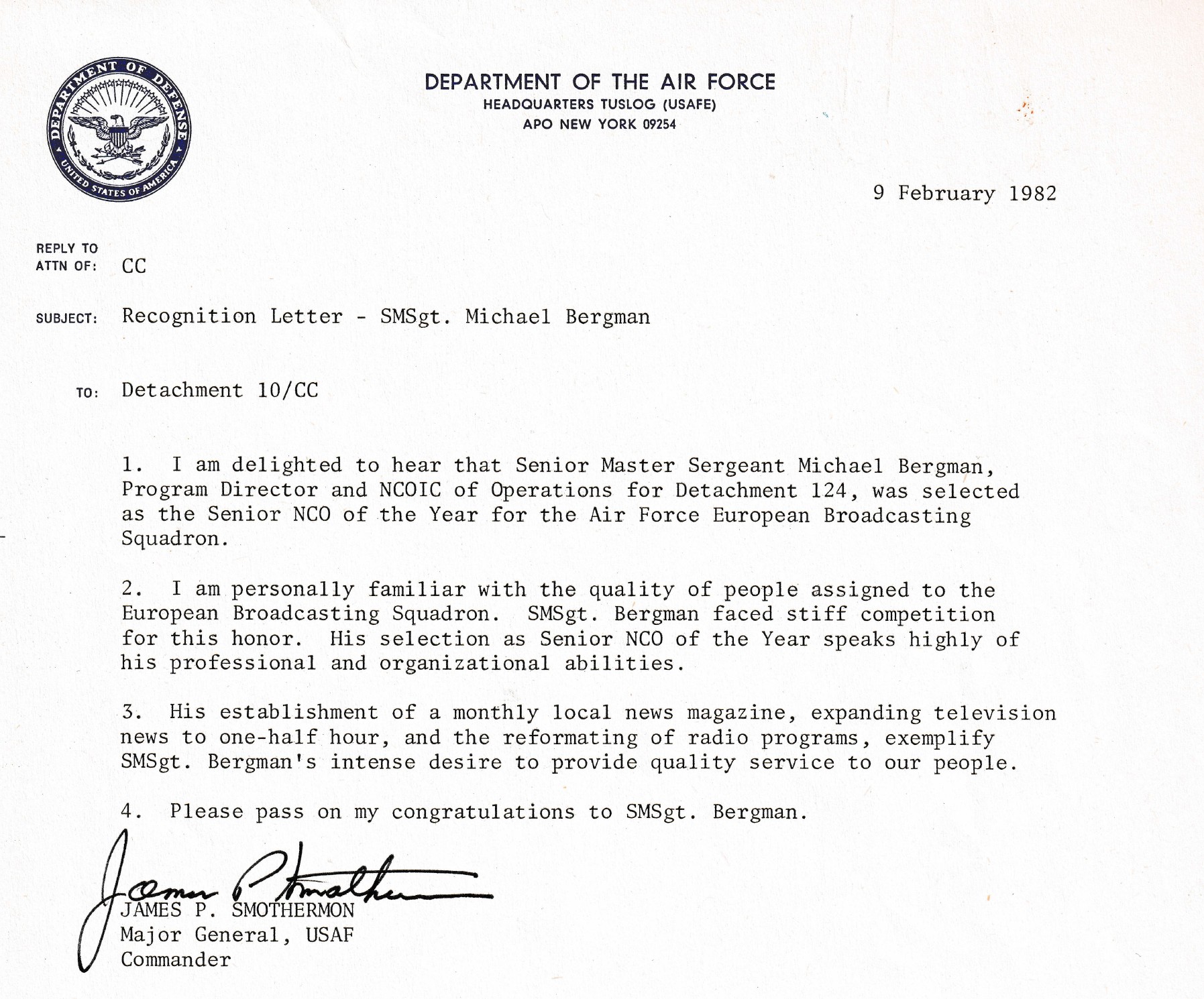
“His selection as Senior NCO of the Year speaks highly of his professional and organizational abilities.”Maj. Gen. James P. Smothermon, commander, Headquarters TUSLOG (USAFE)
Tap the letter to examine it at full size.