The Next Command
With my Greenlandic interlude over, I was about to return to work that wasn’t limited to a global stage, but encompassed outer space. I arrived at NORAD expecting to work in a broadcast studio. How quickly the job would widen. NORAD was at the intersection of space surveillance, missile warning, continental air defense, and the shared responsibilities of the United States and Canada. The assignment became one of the most significant of my Air Force career.
Headquarters in Transition
The headquarters was in transition when I arrived in early January. Gen. Daniel "Chappie" James Jr. had suffered a heart attack and left the dual NORAD and ADCOM command on Dec. 6, 1977. He became special assistant to the Air Force chief of staff, while Gen. James E. Hill assumed command in Colorado Springs. The change was recent enough that Gen. James still seemed very much part of the place.
He officially retired from the Air Force on Feb. 1, 1978, for health reasons. Gen. Hill, meanwhile, was beginning his tenure at the Chidlaw Building, the downtown headquarters shared by NORAD and ADCOM. I was entering a headquarters culture that was adjusting to new leadership while the Cold War mission continued without pause.
Finding My Place
Tech. Sgt. Dick Chase was preparing to depart on a remote tour in Alaska. He showed me the broadcast studio and helped me learn the headquarters routine. My initial interview was with Lt. Col. Robert J. O'Brien Jr., who would soon be promoted to colonel and become the command director of information. He was candid with me. He said he had little experience working with noncommissioned officers and was not sure what he was going to do with me.
I also made it clear that broadcasting was only one part of my background. I had worked in all three areas of the information career field: news media, internal information, and community relations. I had already seen how rapidly a military story could become a national story during the 1973 DEFCON III alert at Homestead. That experience gave me some early credibility. O'Brien may not have known what to expect from an NCO broadcaster, but he soon learned that I could work beyond the studio.
My intentions were clear: I wanted the assignment to use the full range of my public affairs experience.
Cosmos 954
The first major news event came only a few weeks after my arrival and immediately drew international attention. On Jan. 24, 1978, Cosmos 954, a Soviet nuclear-powered surveillance satellite, crashed across a broad area of northern Canada. NORAD had been tracking the satellite, but the radioactive re-entry suddenly made the command's space surveillance mission a matter of intense public interest. I was called upon to help answer media calls.
Cosmos 954 did not make me an expert on orbital mechanics. It did teach me how quickly a classified or highly technical culture could be pushed into public view. The public affairs problem was not to disclose what should remain protected. It was to explain what could be said, promptly and accurately, when the rest of the world was already asking.
The Call About Chappie James
A month later, early on Saturday morning, Feb. 25, I received the kind of call no public affairs person wants. Colonel O'Brien told me to come to the office. "We need you." I drove the several miles to the Chidlaw Building and learned that Gen. Chappie James had died in Colorado Springs overnight, only twenty-four days after his retirement. The same general who Colonel O’Brien had told reporters two months earlier had experienced “a mild, non-disabling coronary event.”
The Office of the Assistant Secretary of Defense for Public Affairs wanted us to make the announcement. I went through the audio material Dick Chase had compiled for shipment to Tuskegee, where it would become part of the institute's archives. I pulled two actualities from Gen. James's recent retirement remarks and began working through the list of broadcast outlets, starting, as I remember it, with CBS Radio News.
The assignment closed a personal circle. During the 1973 Middle East crisis, I had heard Gen. James give direct instructions after an inexperienced lieutenant was quoted too broadly on network television. Now, five years later, I was helping announce his death. I had arrived at NORAD thinking of myself as a broadcaster. That Saturday morning, the responsibility felt much larger than a studio job.
Becoming Part of Command Information
With interest in Cosmos 954 subsiding, O'Brien had me move from my isolated studio desk to the main public affairs office up the hall, near the command section. I spent most of 1978 toiling in the internal information program, working under Maj. Jerry C. Hix and Senior Master Sgt. Billy Helms, while continuing to handle broadcast duties. I produced radio news releases, contributed to "Air Force Weekly," wrote and edited feature material, and became a critic and adviser for command newspapers. My performance report noted that the command's newspapers won five Air Force awards and credited me with three awards in the command contest. Taken together, the work showed how far the assignment had moved beyond the original broadcaster's slot.
The common thread was translation. The command dealt in complicated systems, sensitive missions, and institutional language. My job was to highlight achievements that our workforce, the wider U.S. force, and Canadian service members could relate to. I stripped away acronyms and technical jargon to prepare audio reports the public could understand.
I also immersed myself in a copy of The Tongue and Quill, the publication used to train officers as part of their professional military education. If I wanted to be a major-command staff NCO, I had to learn the intricacies of staff work and communication. I eventually became so attuned to staff work that I knew when our Gen. James E. Hill corresponded with Gen. James A. Hill, the Air Force vice chief of staff, he signed as "Erskine" and received polite replies from "Arthur."
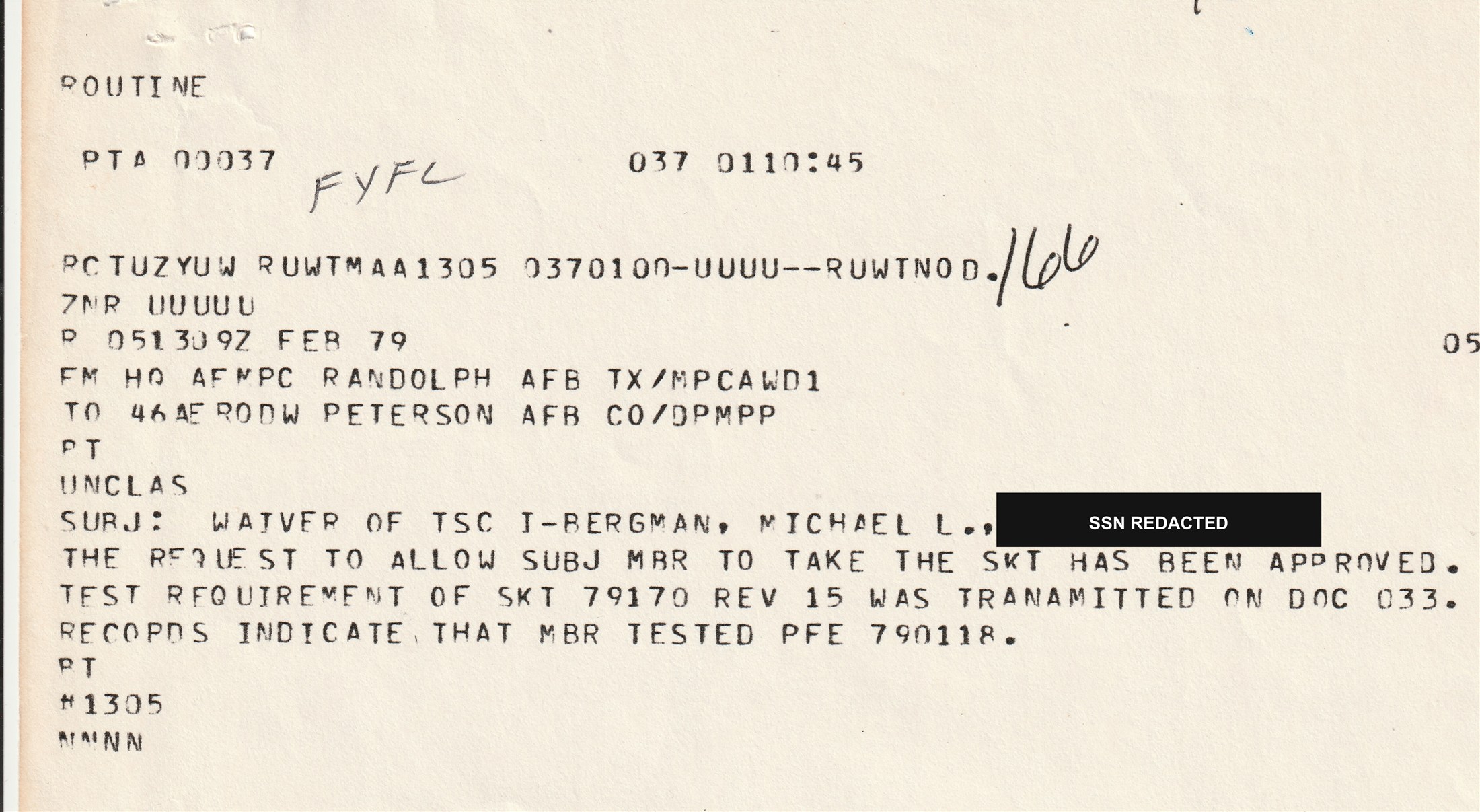
With me shouldering more mainline public affairs responsibilities, broadcasting duties took only a fraction of my time during those spring and summer months. I knew Dick Chase loved the job, had family in Colorado Springs, and had cultivated relationships with local radio and television media. I requested a shift to a vacant public affairs position, freeing the broadcast slot for Dick's return. I also sought a waiver that allowed me to test for master sergeant as an information specialist rather than solely as a broadcaster.
NORAD Tracks Santa
With Tech. Sgt. Chase still on his remote tour, my broadcast workload increased dramatically as autumn turned the Rocky Mountain aspens golden. The most familiar program was also one of the largest productions. My 1979 performance report says I produced and distributed a record 700 copies of the "NORAD Tracks Santa" radio program to stations in the United States and Canada. It was a holiday feature, but its scale made it a major command information product and gave a broad audience a friendly way to understand NORAD's tracking mission. Dick's accounting, as I remember it, showed that the reports ultimately reached more than 3,200 radio stations worldwide.
I tried to find copies of my work when I began compiling these memories, but only a broadcast audio cartridge seems to have survived. We built the program around the origin story: in 1955, a child trying to call a department-store Santa misdialed and reached the Continental Air Defense Command operations center, where Col. Harry Shoup answered and gave the child Santa's status. The program later underwent numerous format changes, outgrowing its radio-only drama. It has become an annual tradition, with NORAD families, friends, and other volunteers answering the calls.
Along the way, I also came into favor with the command section as the on-call narrator for awards and retirement ceremonies, most of them involving general and senior officers. My most memorable one was the retirement of the Canadian lieutenant general who served as NORAD's deputy commander; I cannot yet recall his name. He had been a cavalry officer early in his career and wanted to go out as one. He arranged the ceremony for dusk at the Peterson Air Force Base parade ground. At the conclusion, he mounted a horse and quite literally rode off into the sunset.
As 1979 dawned, Dick Chase was returning, and with the drawdown of Aerospace Defense Command units, my internal information duties were diminishing. One of my frequent duties was to escort media representatives and influential citizens for tours and interviews at the Cheyenne Mountain complex. Dick handled most of the electronic-media tours, including an entire week with ABC's Ted Koppel for his groundbreaking "Second to None" reports on the network's evening news and a documentary.
One of the visitors I escorted was kind enough to send a thank-you letter, which reached me through Gen. Hill.
DOCUMENTARY FEATURE
A Visitor Writes to Command
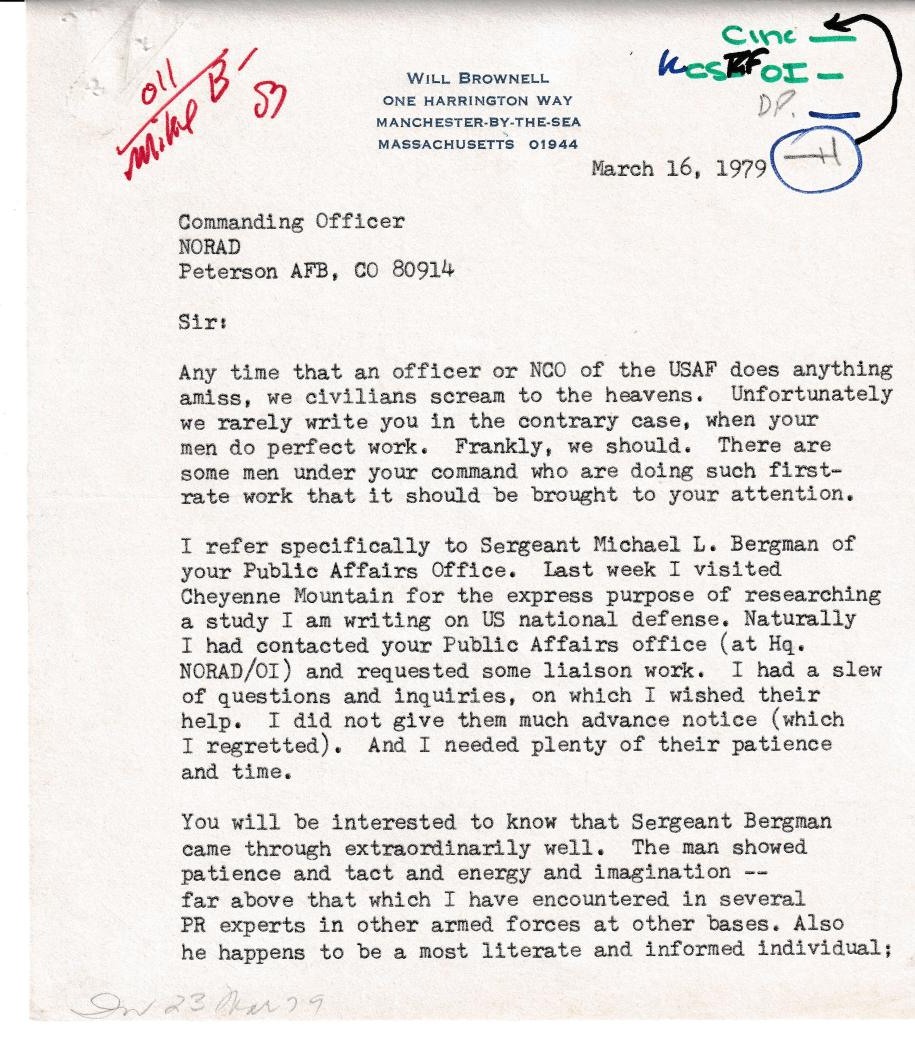
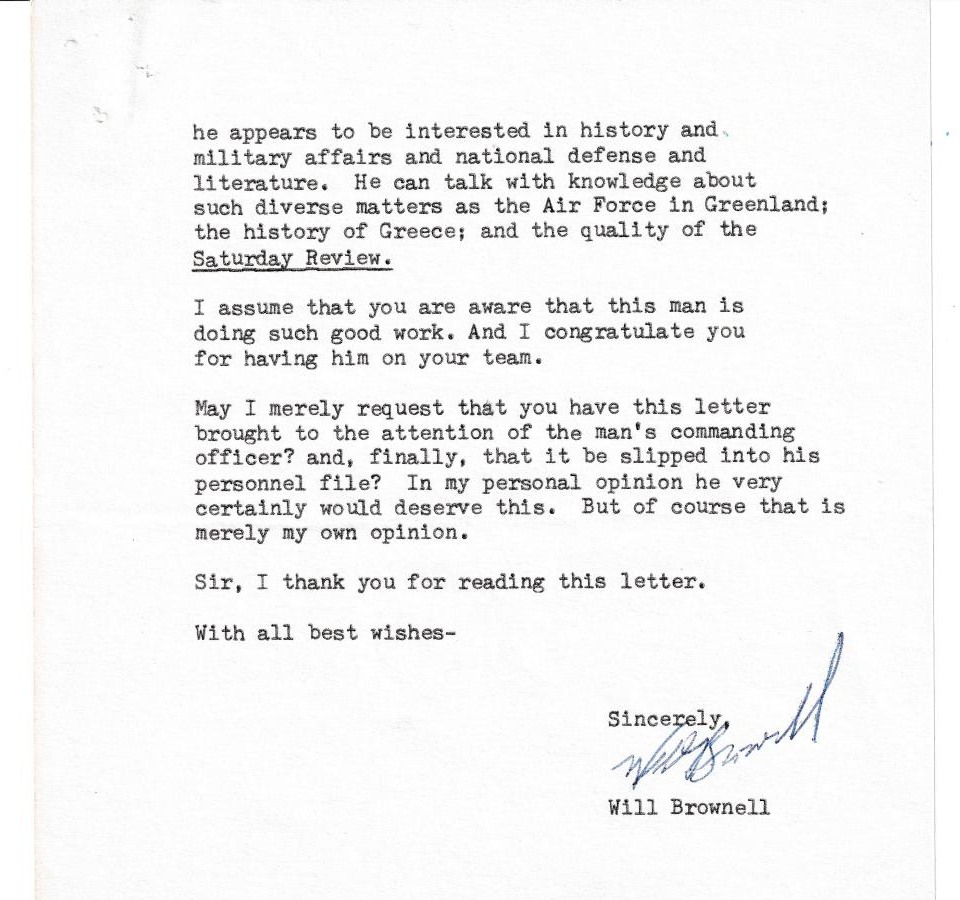
"The man showed patience and tact and energy and imagination"Will Brownell, March 16, 1979, letter to NORAD's commanding officer.
Wikipedia cross-reference. Wikipedia identifies Brownell through his collaborations: co-author of The First Nazi with Denise Drace-Brownell and co-author of So Close to Greatness with Richard N. Billings. Publisher biographies describe him as a military and academic researcher who served in the U.S. Army and State Department. Those details are consistent with this letter’s statement that he was researching U.S. national defense.
Skylab
Skylab's return to Earth in July 1979 created a very different kind of public fascination. The eighty-five-ton space station was dropping out of orbit, and no one could say with certainty where the surviving pieces would land. NORAD could track it with extraordinary precision, but the closer it came to re-entry, the more public interest and anxiety increased.
Colonel O'Brien showed considerable confidence in me when he placed me with veteran civilian media-relations specialist Del Kindschi. As NORAD and ADCOM's space missions had expanded over the years, Del had become our "go-to" space expert. With interest in Skylab's demise cascading, he needed help.
I developed a comprehensive information plan, prepared detailed fact sheets, and worked long hours responding to hundreds of requests for information and interviews. Contemporary clippings identify me as a NORAD spokesman explaining orbital thresholds, likely time windows, and what the tracking network could and could not determine. One account called Skylab "the most elaborately tracked man-made object in history." The technical facts mattered, but so did the ability to explain uncertainty without creating more alarm.
I vividly remember one media query. Kathy Sawyer, a premier reporter with The Washington Post, called. I immediately knew this was one for Colonel O'Brien, the type of "hardball" he relished with national media. But the colonel was out of the office, traveling somewhere with Gen. Hill, and Sawyer stressed that she was on deadline. She was doing a story on people wagering on Skylab's reentry and wanted our take on it.
"Come on, you can tell me about your NORAD pool," she said. "Jody Powell has the Arabian Sea." I truthfully told her, "I'm not familiar with any such pool in this building." I dutifully neglected to tell her that both Colonel O'Brien and I had entries in the Space Center pool at Cheyenne Mountain. I did tell her that any pool should focus on the date and time of reentry, not a place.
Colonel O'Brien, upon his return, was somewhat irate that I had taken the call. After I recited my response to Sawyer, O'Brien immediately called OASD/PA.
"You need to get to Jody Powell and tell him to take this seriously," he said. "Skylab could destroy things and kill people." I was quite relieved when I saw the story in print the next day. Colonel O'Brien was pleased, and I had taken my first swing at hardball.
CONTEMPORARY EVIDENCE
The World Watches Skylab


“But Sgt. Michael Bergman of the North American Air Defense Command (NORAD), which is tracking the satellite, said that the time and place of Skylab’s fall will be difficult to pinpoint, even after it has occurred, and there may be many winners.”Kathy Sawyer, “Skylab Is Eagerly Awaited,” The Washington Post, July 1, 1979
Tap either clipping to examine it at full size.
The Command Changes
Skylab would remain the highlight of my NORAD tour, made more colorful by Colonel O'Brien. Emphasis on space continued to grow. Our air-breathing weapons were transferred to other commands, and air-defense resources were drawn down. Gen. Hill retired, and Colonel O'Brien headed back to Washington.
At about the same time, I pinned on master sergeant stripes. My ploy to test as an information specialist had worked. I continued my streak of being promoted the first time I was eligible.
Col. Fred Watkins arrived as the new command director and, within days, learned who our next NORAD commander in chief would be: Lt. Gen. James V. Hartinger. They had known each other as F-105 pilots at McConnell Air Force Base, and Fred was not a big fan. Ever the gentleman, however, he weathered it and remained the voice of calm when things threatened to become explosive.
I remember the 1980 visit of Chinese Vice Premier Geng Biao, China's senior defense official, and a party of officers. My job was to escort a retired Air Force NCO photographer who worked personally for the defense secretary. The photographer's name escapes me, but he had a renowned portfolio. At Gen. Hartinger's prearranged signal, I would move the photographer into position for the documentary shot. The general expressed his appreciation for my work to those in the Space Defense Center. adding a snide remark to Col. Watkins. Fred simply smiled and moved on.
It was about that time to think about my next assignment. With an escort badge and a small repertoire of Chinese courtesy phrases and directions, I accompanied several visitors when they needed to use "the facilities." The air attache in Peking, whom I remember as a Col. Webb, discussed with me the prospect of embassy duty there. With a young daughter of school age, however, I respectfully declined after hearing him describe the living conditions.
I was relegated to whatever the assignment gods in Texas dealt me. In the meantime, I relinquished many daytime duties and took over the job of preparing the morning news summary for the command section. It worked quite well, and I dealt often with Harry Zubkoff's people at the Pentagon to obtain every page of the coveted Early Bird on our massive "telecopier." Yes, it was a forerunner of the fax machine, which has itself joined the growing pile of obsolete devices.
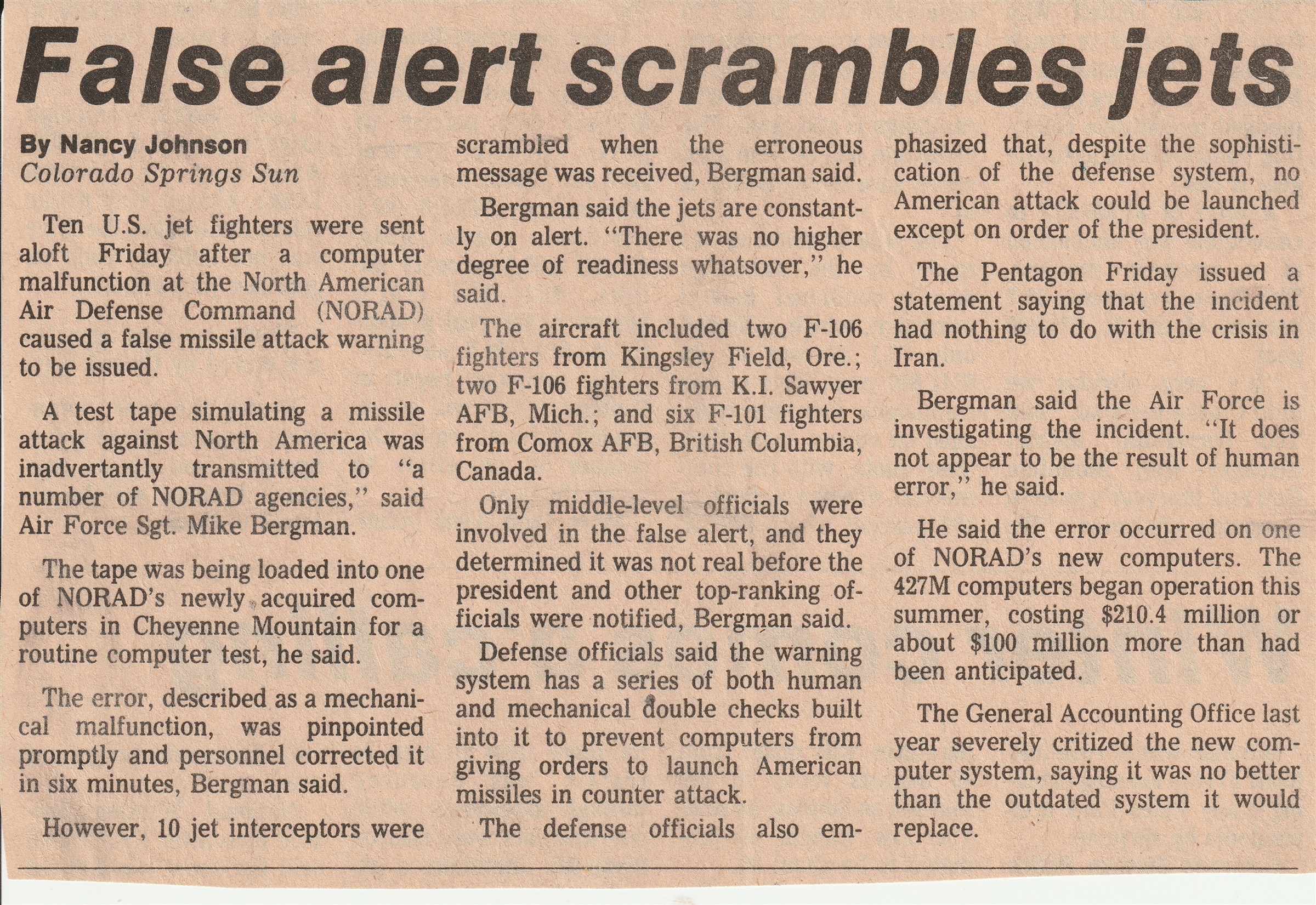
False alert scrambles jets
"There was no higher degree of readiness whatsoever."Michael Bergman, quoted in the Colorado Springs Sun clipping
Beyond the Office
That move also freed more of my afternoons and evenings for work as a sports official. I was now a certified international and high school basketball referee. I could be refereeing a game near the Kansas border one night and at two-mile-high Leadville the next. In other months, I was a well-regarded softball umpire.
One of Gen. Hartinger's sons, a local football coach, was also a talented softball player, and I officiated several of his games. More than once, Gen. Hartinger and his wife, Mickey, watched from their parked car with a couple of beers on the dashboard. "Hey, Sarge, want a beer?" he asked as I was leaving one game. Maintaining an official's code of conduct, of course, I had to decline. Besides, I had my own supply.
"Hey, Sarge, want a beer?"General James V. Hartinger after a softball game. He had served as an Army infantry sergeant during World War II.
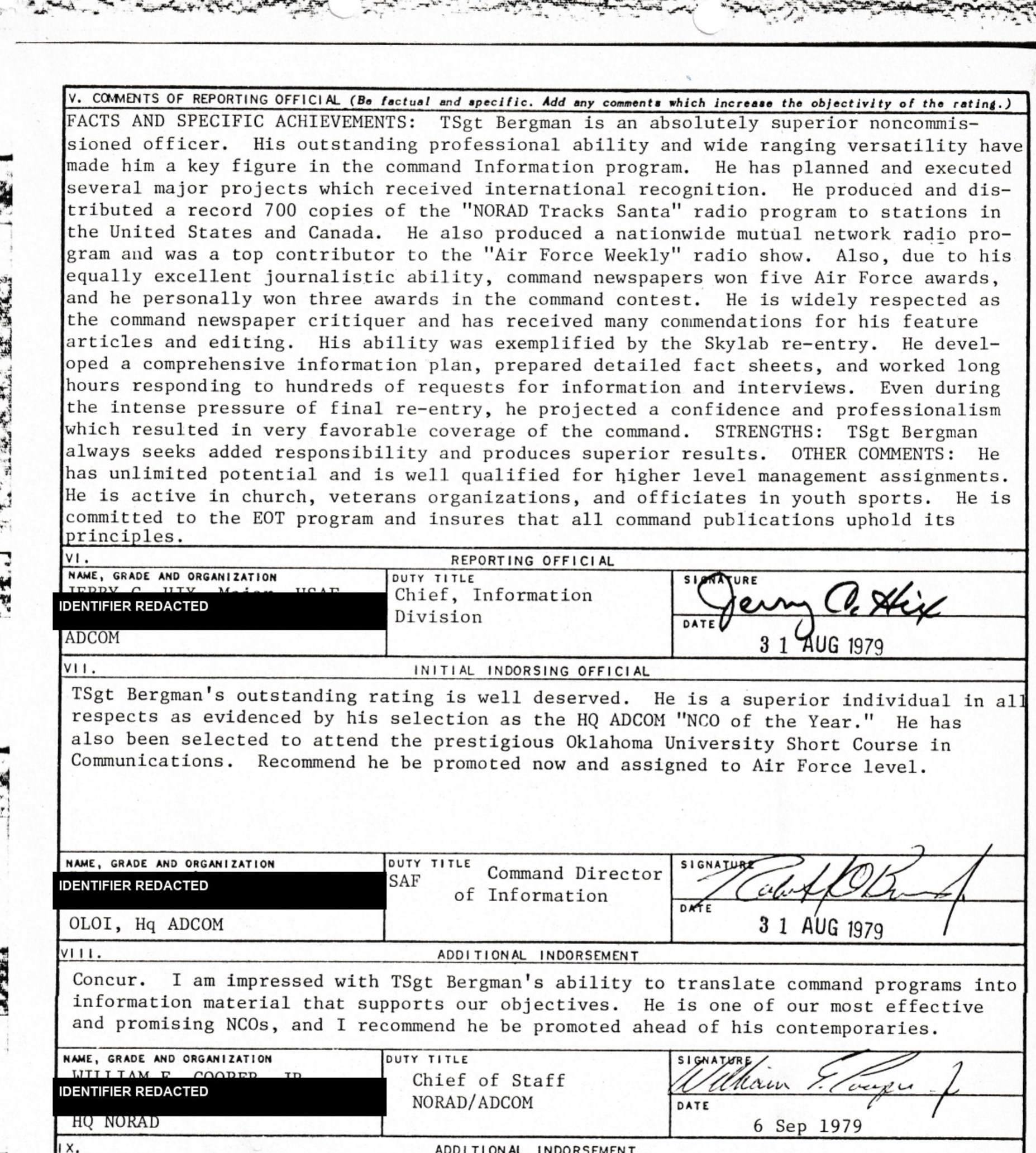
The Record of the Work
From the 1979 NORAD/ADCOM performance evaluation: command-information, broadcasting, and Skylab work.
Toward the Next Assignment
In early 1981, I learned that my next assignment would be at Incirlik, Turkey, most likely as the second-ranking NCO and the radio-television program director. After reviewing every aspect, we decided that I would go on an unaccompanied twelve-month tour. A close friend from my Taiwan assignment, by then a Navy officer stationed at the Defense Information School, had also pitched me for a follow-on assignment there. Indianapolis would be about one hundred miles from our designated home and offered the possibility of a three-year controlled tour. With aging parents and close family members, that was a course we wanted if it could be guaranteed.
My broadcasting Air Force Specialty Code caught up with me once again and would define the next decade of my service. Straight-out public affairs work, however, would always be my "heart and soul."