They Called Us “Supreme” Headquarters in Texas
I arrived at Kelly Air Force Base in May or June 1985. Chief Master Sgt. Mike Kinchen had just retired and would return as chief of operations at the Air Force Broadcasting Service. I became noncommissioned officer in charge of operations, since there was a six-month delay in Mike’s return. I also picked up some of his chief of broadcasting responsibilities. I was keenly aware that there were more senior and experienced noncommissioned officers in the Air Force broadcasting system or serving in other commands. Col. Terrance Mayer and Mike had selected me based on past performance and potential for promotion, but I limited my duties in matters such as assignments and drafting performance reports and endorsements to those junior to me.
The chief of broadcasting responsibilities included personnel management, budgeting for operations and maintenance, equipment procurement, and the AFBS inspection system, which operated under the euphemism of “quality assurance.” My favorite opening line for inspections was “Hi! I’m from headquarters and I’m here to help you.”
The staff consisted of master sergeants who had accumulated vast experience overseas and in broadcasting staff work. They needed no coaching when it came to dealing with the Air Force Service Information and News Center, or AFSINC; following guidance from the American Forces Information Service, an arm of the Office of the Assistant Secretary of Defense for Public Affairs; or working with other commands and the other services' broadcasting activities.
The Job Before the Stripe
It wasn't long after my arrival that the promotion list for chief master sergeant was released. For the first time in my career, I had not earned my next stripe the first time I was eligible. I was crushed and disappointed, to say the least. No other NCO with broadcasting experience had been selected either, and no chief master sergeants were available to move into the vacant chief of broadcasting position. I think Col. Mayer shared my disappointment. He called me into his office to express his confidence in me. "How would you like the job anyway?" he asked. Of course, I jumped at it. The Air Force had not yet selected me for the stripe, but it was apparently willing to let me do the job.
Mark Miller had studied promotions to chief master sergeant in the 791 career ladder and concluded that broadcasters were at a disadvantage because they were not receiving general officer endorsements. Historians within the same career ladder were being promoted at a disproportionate rate, perhaps because they often worked at wing level or above and directly under commanders. My dive into the promotion data at first seemed to confirm this, but then I discovered an underlying problem with broadcasters. They were not completing professional military education courses, and they were not enrolling in correspondence courses or attending schools in person as soon as they became eligible. Completing PME levels appropriate for the desired rank became my mantra for the next several years, not only with broadcasters but with the entire AFBS enlisted workforce.
Changing the Contest Rules
One of the first tasks I faced was supervising the annual Air Force broadcasting media contests. This had become a sore point with me over the years, not because the contests honored radio and television production excellence, but because of some content. We were focusing on broadcasting excellence and skill while ignoring the bigger picture. Radio announcers, for example, were producing what I called "salutes to dead people" every time a rock star passed away. It was outstanding programming, but it had little to do with informing our workforce or supporting our missions. We changed the rules, requiring entries to support internal information and demonstrate audience impact. Our videographers had already been moving in that direction by telling local and command-support stories. It was time to get the entire broadcasting operation in tune.
Col. Mayer was nearing retirement, and Lt. Col. John Worthington had been tapped as the incoming director. Medical holds delayed Col. Mayer's retirement for several months, so Lt. Col. Worthington initially headed the maintenance and logistics support division before moving into the director's chair. Mike Kinchen was now aboard, and I moved into the vacant, stand-alone chief of broadcasting office. There I arranged my first-ever "I Love Me" wall display. When promotions for the 1987 cycle were announced, I was fortunate to be on the list.
Seeing the Stations
I began overseas travel with Lt. Col. Worthington in 1986. It was important to see how our people were performing and to demonstrate that their chain of command not only appreciated their service but was looking out for their welfare. One of our first trips took us to Berlin, where Air Force personnel were working within the Army-managed American Forces Network-Europe. It was beneficial for them to experience some Army training, such as reading compasses and maps, but not okay to adhere to the Army’s more stringent physical fitness regimen. Grooming, appearance, adherence to standards, and good order and discipline applied regardless of the uniform.
The Berlin Wall had not yet fallen. We took advantage of our Allied occupation status to visit East Berlin. Every American should have had that experience. It was drab. There were no smiles, people wore mismatched shoes and clothing, and the air was filled with the smell of smoky East German Trabants and Wartburgs whose two-stroke engines sounded like outboard motors. Slovenly soldiers fondled their weapons in guard towers. Yet the Soviet World War II museum and cemetery were compelling. Through the course of my life, I would see abandoned German bunkers in Crete, Monte Cassino in Italy, and bullet-pocked walls in Berlin. In the Pacific, I would see Pearl Harbor; the room at Yokosuka identified to us as the place where Japan plotted the attack; a site associated with the Bataan Death March; and Ground Zero at Nagasaki. My parents' lives had been rocked by World War II, other relatives were involved in the Korean Conflict, and I had been on the periphery of Vietnam. Now the reality of the Cold War was vividly on display in East Germany. Meanwhile, all of Europe warily scanned the news as the Chernobyl nuclear disaster unfolded.
Overseas trips also allowed me to see and hear some of my former Defense Information School students on the job, earning favorable reviews from their supervisors and beginning to progress up their career ladders. It was a chance to listen to people, hear their concerns and preferences, and assess the climate of each broadcast facility. It helped us get the right people into the right jobs at the right locations while trying to maintain equity in an overseas assignment system that was not always balanced. I had been fortunate to have only two unaccompanied tours; some of our NCOs had four or five. Fortunately, we also had the right people volunteering for and occupying key positions.
Without exception, host-base commanders were pleased with the performance of our Air Force-managed stations. Army and Navy commanders were equally appreciative of the Air Force members serving in their networks and facilities. Our visits often corresponded with commanders' calls and social events, and we sampled cuisines unique to their locales. I used to joke that I especially enjoyed Italy, "eating my way from north to south."
The DINFOS Review
In 1987, I was tasked by OASD(PA) to join counterparts from the other services on a Defense Management Review Team. I had an unfair advantage because I knew most of the people still at DINFOS.
From the Record
William E. Hart to Chief Bergman, June 10, 1987
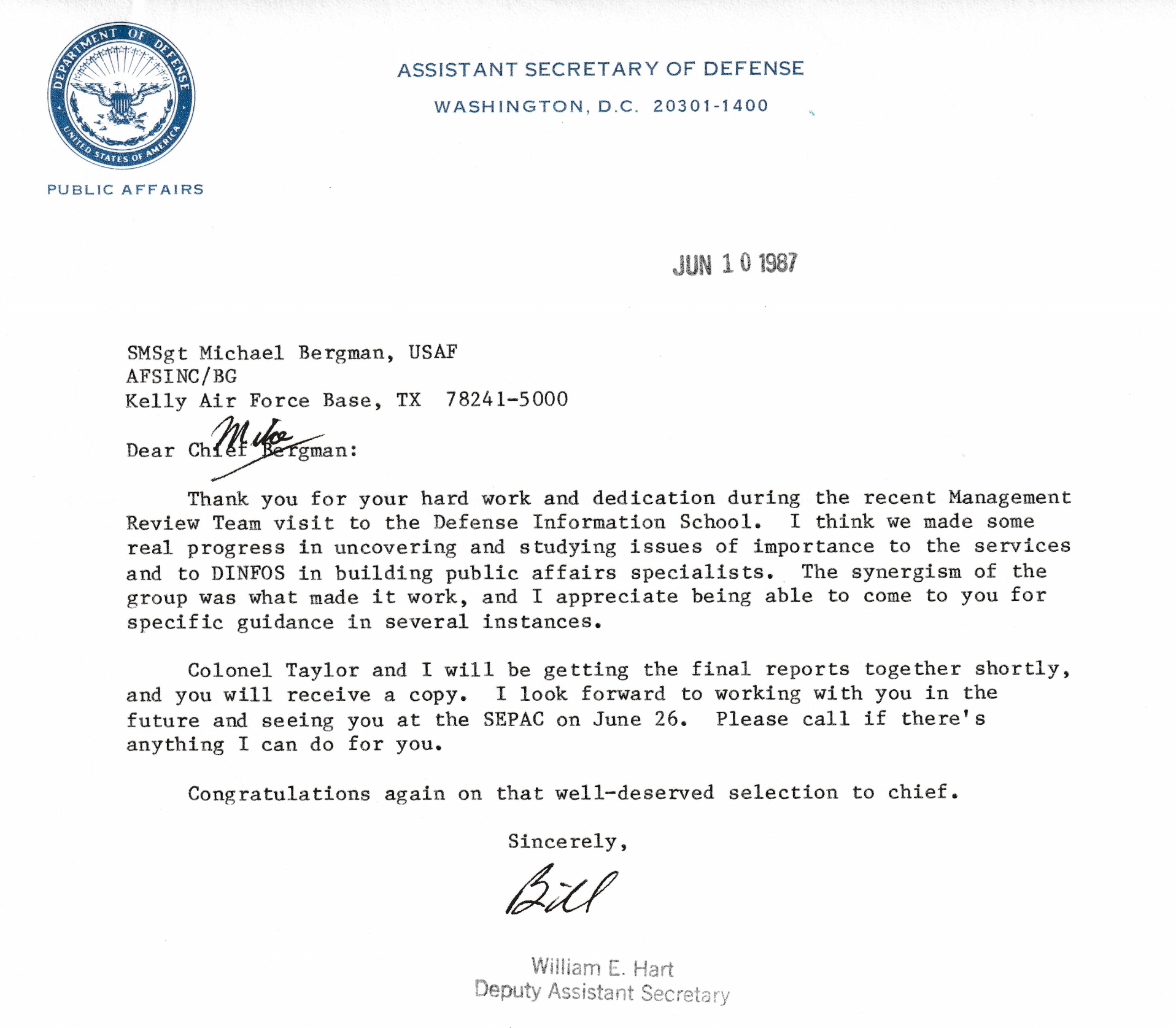
Tap the letter to examine it at full size.
ONE OF OUR BEST AND BRIGHTEST
Steve Hull
One of the most difficult tasks I faced in my career was to accompany Col. Worthington as we informed Deborah Hull of her husband's grave injuries and that he was not expected to live. I had brought Steve into AFBS headquarters to help implement the introduction of desktop computers into our worldwide operations. I promised Steve's father I would evoke his memory at every appropriate opportunity.
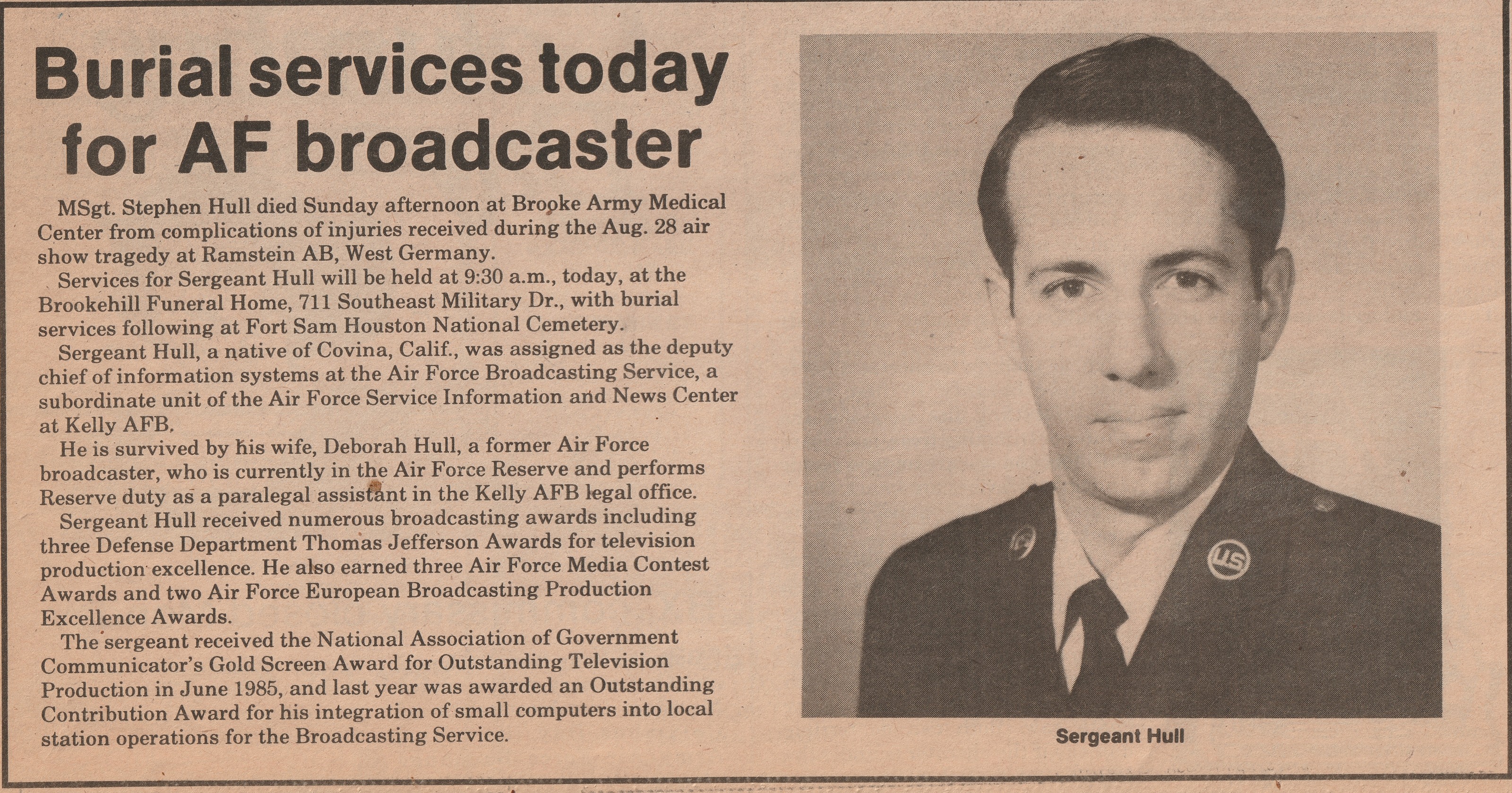
Tap the clipping to examine it at full size.
A major disappointment came when John Worthington's name did not appear on the selection list for O-6. He went on to become director of public affairs for Electronic Security Command, continuing to excel in serving the Air Force's silent warriors and establishing relationships that would result in a distinguished post-service career in San Antonio. I believe every senior enlisted adviser probably keeps a short list of O-5s who should have become full colonels, and perhaps a handful who would serve better by remaining O-5s. But enlisted people don't sit on officer promotion boards.
In 1989, Col. Ted Tilma became AFBS director after his promotion and move from Alaska, and he quickly began operating at full speed. We visited our operations in Europe and the Pacific, where he could see for himself the outstanding work our people were doing day to day.
One Broadcasting Team
I also placed emphasis on our maintainers and logistics people. Just as walls often separated broadcasters from mainstream public affairs, broadcasters and maintainers had sometimes been walled off from each other at stations around the world. I was determined to help shape a unified broadcasting service team at all our locations.
Broadcasting was undergoing such rapid changes that equipment was beginning to drive operations. Maintainers who had once dealt with tubes and crossed wires had moved on to circuit boards and were now talking about EPROMs - erasable programmable read-only memory. The digital age was upon us. We needed maintainers who were not only experienced but also current on technology that seemed to change at six-month intervals. Maintenance shops once heavy with smoke from soldering irons and cigarettes had given way to smoke-free clean rooms for troubleshooting cameras, chips, control boards, and embedded sensors.
The Desktop Arrives
The late 1980s marked the beginning of my transformation into a curious seeker of knowledge about a promising new tool for productivity, the desktop computer. It opened new possibilities for delivering information. Air Force Capt. Dave Nuttall demonstrated simple computer routines for broadcast operations during his tour as a Far East Network commander in Okinawa. He was brought aboard to help us develop the Air Force Broadcasting Service portion of a new AFIS-directed computer system: the Organized Network of Extended Terminals, or ONET. Those of us in the know knew it was also a moniker for the systems guru, affable Army Lt. Col. Mike Paterson. "That's one t."
Two decades after marveling at the electronic typewriter in Col. Gabreski’s office, I was intrigued by AFBS secretaries using memory typewriters. Soon, a new behemoth would sit on most of our desktops. To keep pace with my lifelong communications journey—from print to airwaves to cyberspace—I would have to master another learning curve. The opportunity was about to arrive.