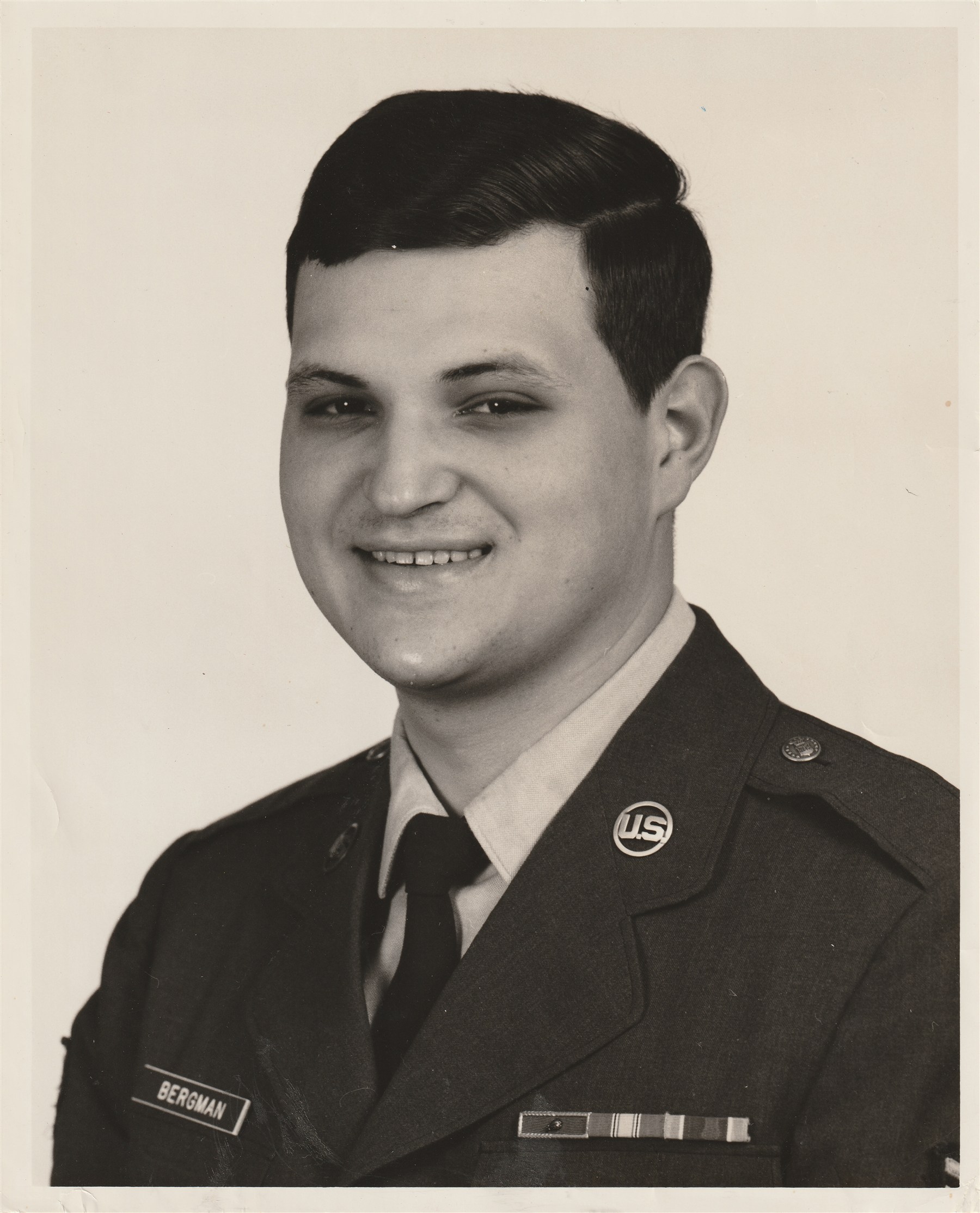
The Crash Kit
On Friday afternoon, April 19, 1968, I was in the Commander's Information Office at Suffolk County Air Force Base when an officer from the safety office hurried past and announced that an aircraft had crashed. Capt. Jim Craig, our information officer, had taken a well-earned afternoon off to go fishing. Only a handful of us were in the office.
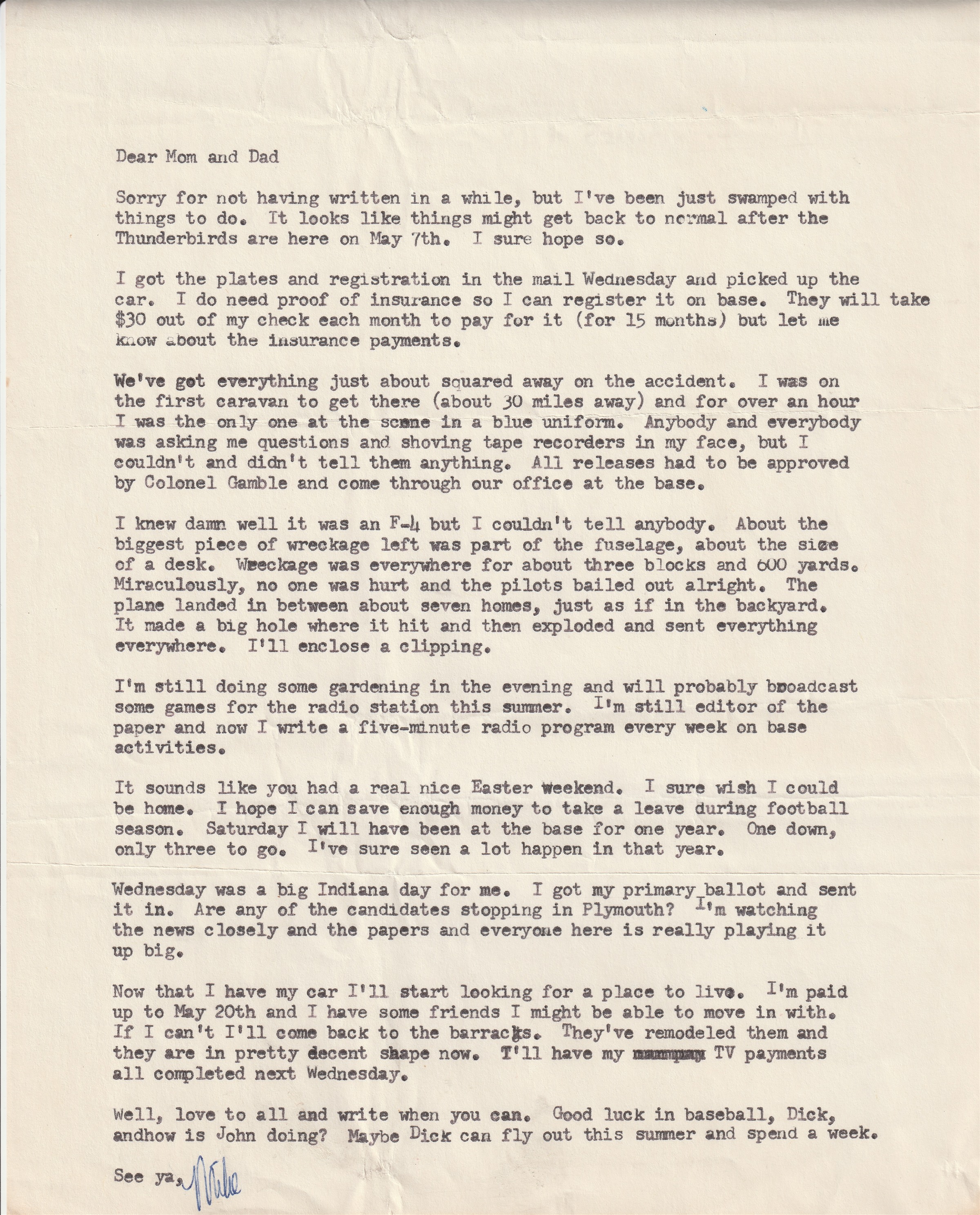
I grabbed the crash kit and climbed into an emergency vehicle with the wing safety officer. We headed west toward Bayport, where an F-4D Phantom assigned to the 479th Tactical Fighter Wing at George Air Force Base had come down in a residential neighborhood. The two crew members had ejected safely, but pieces of the aircraft struck several homes. When we arrived, houses were still burning or smoldering and wreckage was scattered through the area.
For what seemed like hours, I was the only person at the scene in a readily recognizable Air Force uniform. That did not make me the senior Air Force authority, but it certainly made me the person reporters could find. Many were convinced that the aircraft was an F-111, then a controversial subject and of particular interest on Long Island because of Grumman's involvement in the Navy version. I could confirm that it was not an F-111. At first, there was little else I could responsibly confirm.
After word reached us that the crew was safe, I concentrated on keeping reporters away from hazardous wreckage until explosive devices associated with the cockpit and ejection system had been accounted for. Capt. Craig did not reach the scene until after darkness fell. By then I was exhausted, but I had followed the accident-response procedures as I understood them and kept detailed notes and diagrams. Some of those notes were later used in the formal investigation. I believe the episode also led to my nomination for Airman of the Quarter.
I had been in the Air Force a little more than a year. How a former small-town sports editor became the visible Air Force spokesman at a burning aircraft-crash scene requires some explanation.
News Arrives in Plymouth
My first encounter with news came at the railroad depot in my hometown of Plymouth, Indiana. During Dwight Eisenhower's 1952 presidential campaign, I watched him give a brief rear-platform speech from his campaign train. I was young, but the combination of a national event, a crowd and a famous person appearing in an otherwise familiar place made an impression.
We did not get our first television until about 1954. With it came the evening news and the early space race. Everyone knew about the atomic bombs that had ended World War II, but now the question was rockets and which nation was ahead. My father followed every launch. Whenever an Army rocket failed, he would ask, with increasing irritation, “Why don't they let the Air Force do it?” His impartiality on interservice matters was never especially burdensome.
My father also seems to have guided many of my Christmas and birthday gifts. There was a toy typewriter, small printing press and, eventually, a radio that allowed me to tune in shortwave broadcasts and hear news from distant places. Whether he intended to create a future journalist and Air Force information specialist I cannot say, but he certainly provided the equipment.
In high school I edited the school newspaper and landed a leading role in the senior play.
By my senior year, someone at the Plymouth Pilot-News, our local daily newspaper, encouraged me to cover sports. I believe a creative-writing contest sponsored by the paper helped open the door. After graduating from high school in June 1965, I became the paper's full-time sports editor.
It was still a hot-lead daily newspaper. The composing room carried the smell of molten metal and ink. Typewriters clattered, teletype machines rattled, Linotype operators worked with scarred and battered hands, pressmen wrestled with machinery, and a layer of cigarette smoke always seemed to hover over the entire scene. It was noisy, dirty, demanding and wonderful. I was learning the newspaper business from the inside and having the time of my life.
The difficulty was that “full time” frequently meant 50 to 70 hours a week. For a sports fan, the job also offered a version of paradise: press-box tickets to Notre Dame football games during the 1966 national-championship season and meeting members of my favorite Chicago Cubs during a media tour. At the same time, I was carrying a full course load at Indiana University's South Bend campus. Full-time student status mattered because the military draft was no abstraction in the middle of the Vietnam War. By January 1967, I finally admitted that I could not continue doing both jobs well.
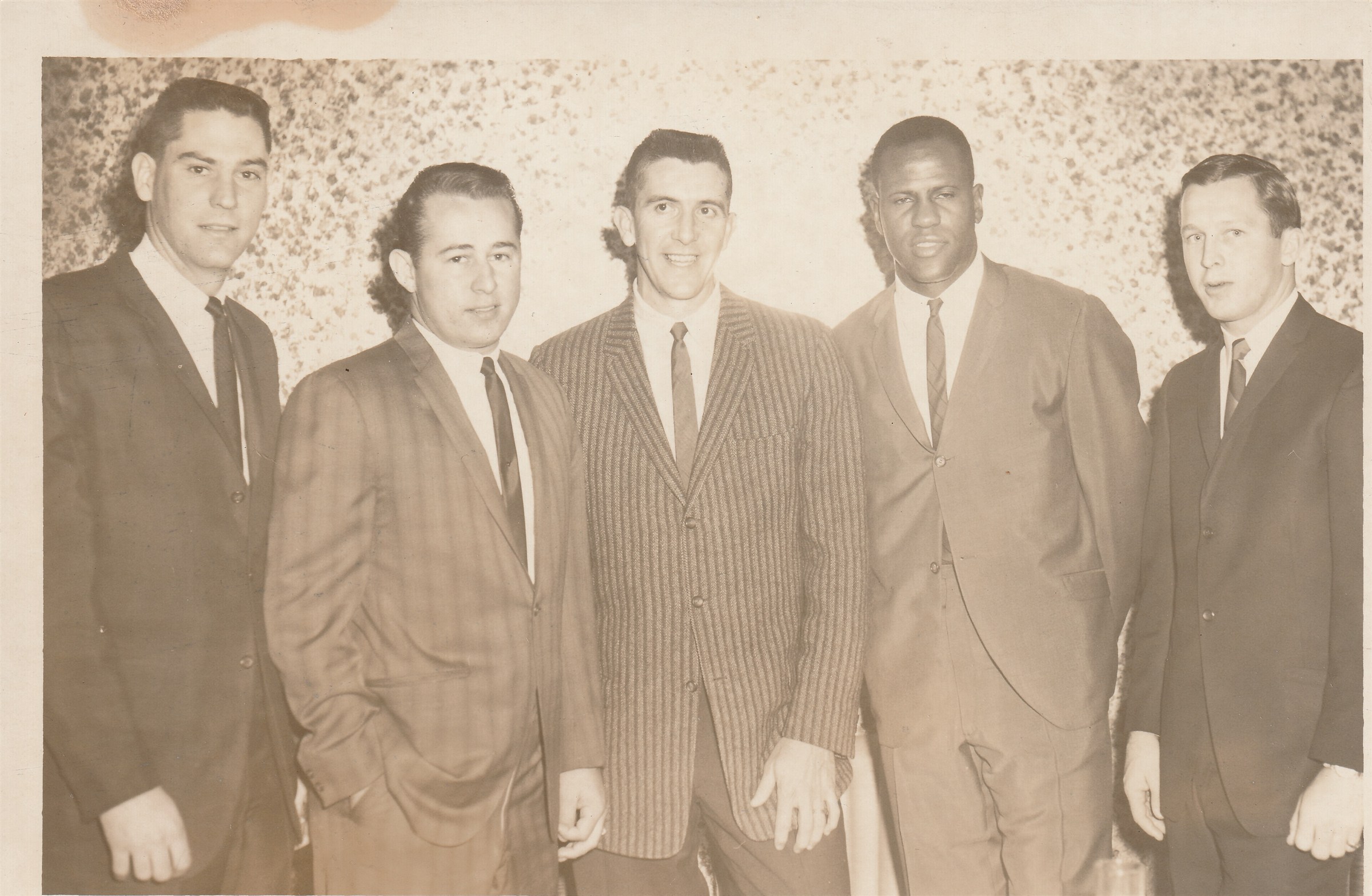
The Pink Building
No military service other than the Air Force was seriously on my list. I contacted the recruiter, took the qualifying tests and scored well enough to enlist. His quotas were limited, so he told me to be patient until I was scheduled for my physical. About four weeks later, off I took the oath of enlistment.
Before I left, the recruiter gave me one valuable piece of advice: when I reached “that pink building” at Lackland AFB, Texas, and was asked what I wanted to do, I should insist on taking the bypass specialist test for Air Force Specialty Code 72130, information specialist. The advice worked.
At the end of basic training in April 1967, I was the only airman in my flight to receive a direct-duty assignment. Most of the others boarded buses for technical training in whatever specialties the Air Force needed. I received 20 days of leave and orders to report to Suffolk County Air Force Base, New York. I was on my way.
Suffolk County Air Force Base
Source document · Suffolk performance report
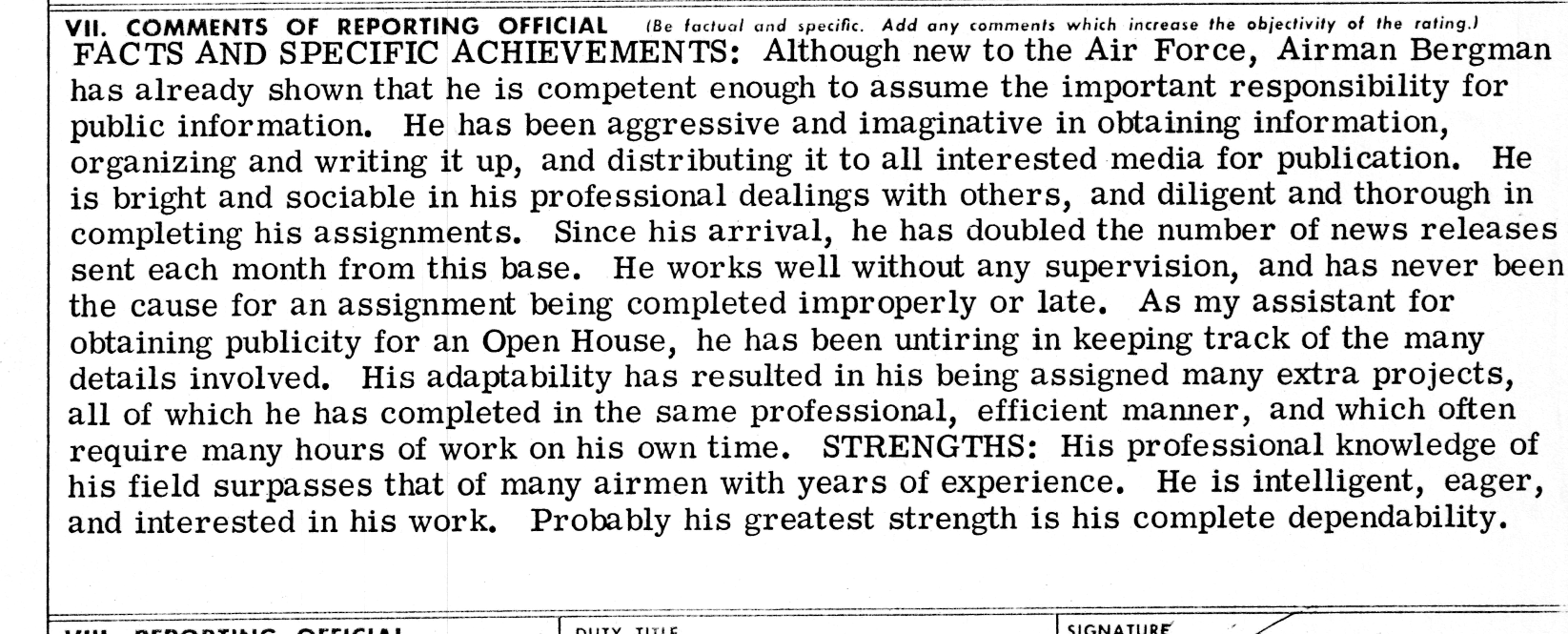

The 52nd Fighter Wing Commander's Information Office—what would now be called a Public Affairs office—was led by Capt. Jim Craig. There was no senior noncommissioned officer in charge, only a collection of first-term airmen in various stages of learning their jobs. Because I already had newspaper experience, I quickly became editor of the base newspaper, the Suffolk Sentinel.
As always in a small information office, the newspaper was only part of the job. I led base tours, answered public inquiries and even reviewed letters claiming alien encounters as part of Project Blue Book.
I received my first classified briefing. The F-101B Voodoo interceptors on the flight line and in the alert shelters were not merely fast aircraft waiting to chase unidentified airplanes. They could carry nuclear-tipped AIR-2 Genie rockets intended to destroy formations of incoming Soviet bombers. Suffolk's mission was the air defense of New York and the surrounding region. The Cold War was not an abstraction there. It sat armed in alert pods.
Readiness was a constant priority. I remember one morning when both fighter squadrons flushed—launched in rapid succession—putting what I remember as 36 jets into maximum-power climbs, each with both afterburners firing. The sound carried across the Hamptons and produced an impressive collection of noise complaints.
New York, Off Duty and Otherwise
An airman's life was Spartan in those days. Capt. Craig, through his friendship with Lieutenant Dave Kraus in personnel services, helped arrange quarters and separate-rations allowances for me and another airman, Joel Bermant, to live off base.
I had no automobile, so we improvised carpools and enjoyed the independence. I could not afford a television. My evenings were often spent listening to WOR radio and Jean Shepherd, whose stories ranged from his Indiana boyhood to military service and assorted observations on American life. Some of those stories later became the beloved movie A Christmas Story. A master storyteller.
The city and country were becoming increasingly unsettled. The Six-Day War erupted in June 1967. Newark and Detroit experienced major racial uprisings that summer. Antiwar demonstrations grew. In 1968 came the Tet Offensive, the assassinations of Martin Luther King Jr. and Robert F. Kennedy, and continuing unrest at home and abroad. We were defending New York against Soviet bombers while much of the immediate turmoil seemed to be unfolding inside the country we were defending. First-term airman Tony Kidney hadn't shown up at the office in days. Then, one night, he showed up on a New York City television newscast alongside H. Rap Brown. Massive societal changes and increasing opposition to the Vietnam War were no longer abstractions.
Gabby and Bergie
The most memorable part of my Suffolk assignment was working for Col. Francis S. Gabreski, commander of the 52nd Fighter Wing and then the nation's leading living air ace. He was “Gabby” to senior friends and “Colonel” or “sir” to me. He called me “Bergie.”
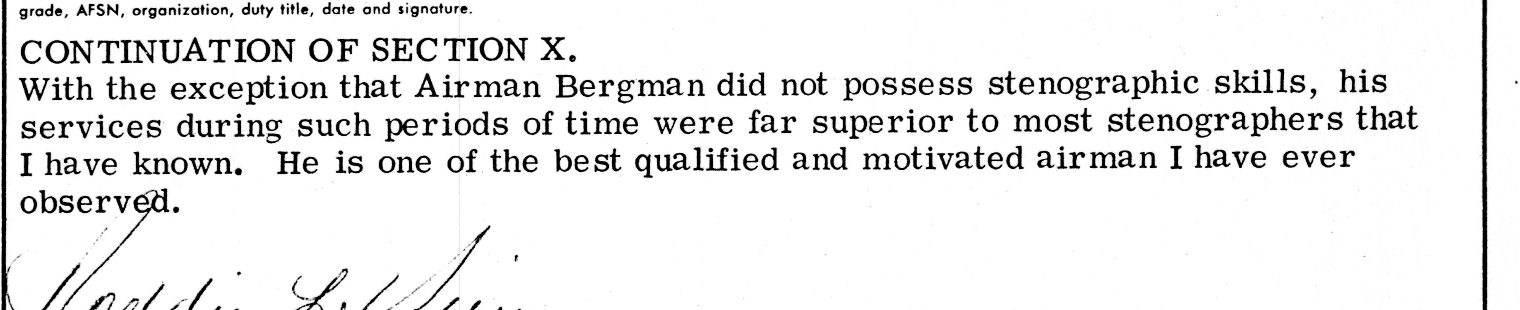
When his civilian secretary, Virginia Kelly, was injured in an automobile accident and faced a lengthy absence, Capt. Craig recommended me as the temporary replacement. My typing skills, acquired during two years of high school typing, suddenly earned me an electric typewriter and a desk in the wing commander's office. I answered calls for Gabreski and Col. Roddie Kile, the wing executive officer and another World War II veteran, and received a close view of senior Air Force business.
From Col. Roddie L. Kile's December 1967 endorsement
Gabreski had been a colonel for many years, and he had friendships and contacts far beyond the normal reach of a wing commander. One day Gabreski gave me a telephone number at the Pentagon and asked me to place the call. It turned out to be the office of Secretary of the Air Force Harold Brown. When the connection was made, I heard Gabreski say, “Brownie, this is Gabby.” That brief exchange said more about his standing than any organizational chart could have managed.
“Brownie, this is Gabby.”
Another memory has stayed with me for nearly 60 years. At a Friday formation, Gabreski presented the Silver Star to a captain for heroism in Southeast Asia. The war felt distant from our air-defense base on Long Island, but the medal brought it directly in front of us. The following Monday, while serving as Gabreski's temporary secretary, I saw the captain's request to resign his commission come through for signature.
Knowing what had just taken place, I asked Gabreski if he was sure he wanted to approve it. As I remember his reply, he said, “Bergie, yes. If a man's heart isn't in it, it's time for him to move on.” Those words remained with me throughout my career.
“Bergie, yes. If a man's heart isn't in it, it's time for him to move on.”Col. Francis S. Gabreski, as Mike remembers it
As Gabreski's Oct. 31, 1967, retirement approached, the information office handled numerous telephone interviews and the comparatively rare in-person interview. Calls came from national news organizations and even the BBC. One line I remember him using was, “The longer you stay up in the air shooting down airplanes, the luckier you have to be.” It captured his combination of experience, confidence and realism.
Ten Days in April
April 1968 compressed national tragedy and local emergencies into a remarkably short period. Martin Luther King Jr. was assassinated on April 4. Five days later, a major brush fire swept through the area west of Suffolk AFB and threatened the installation.
I was in the command post as the fire escalated. Of particular concern was the alert area where nuclear-armed interceptor aircraft stood ready for the air-defense mission. Contemporary newspapers reported that the base itself was threatened, but they did not disclose the danger to the alert aircraft.
Westhampton Beach volunteer firefighter George D. Raynor was killed during the response. Whatever place the fire ultimately occupies in my own story, his death belongs in the account. It was not merely another readiness exercise or a dramatic day at the command post.
Ten days later came the Bayport F-4 crash and the hurried trip with the wing safety officer described at the beginning of this chapter. In scarcely more than a week, I had watched one emergency threaten the base and then found myself serving as the visible Air Force representative amid another emergency in a Long Island neighborhood. That was a substantial amount of practical training for an airman still relatively new to both the service and military public affairs. And we had an open house featuring the Thunderbirds on May 7, adding to my community relations checklist.
Original letter · April 1968
Letters Home
A surviving letter from the Suffolk period—kept here as documentary texture. It remains an artifact in Mike’s own hand and voice, not raw material for silent rewriting.
Learning to Be an Air Force Information Specialist
Col. Jack K. Gamble succeeded Gabreski as wing commander. A decorated World War II night-fighter pilot, Gamble had flown 93 combat missions in Bristol Beaufighters and later retired as a major general. He valued the information program and the base newspaper. When a new military newspaper editor course was established at Fort Benjamin Harrison, Indiana, Capt. Craig recommended that I attend and Col. Gamble approved.
Mine was only the second iteration of the three-week course at the Defense Information School.
Only a few weeks after I returned to Suffolk, a message went to Air Force information offices announcing a critical shortage of broadcasters. Airmen in the 721X0 career field were encouraged to apply. On the strength of my limited earlier broadcasting experience, I completed an audition and submitted a tape. To my surprise, I was selected.
I returned to Fort Benjamin Harrison and the Defense Information School in August 1968. Some Air Force instructors were surprised to see me again and wondered whether the newspaper editor course had been wasted, now that I was becoming a broadcaster. That reaction reflected a real division within the information career field. Print, community relations and public information formed one side; broadcasting formed another. Small base information offices rarely had assigned broadcasters, and most broadcasting positions were overseas or at a few specialized stateside activities.
Orders for Crete
When I returned to Suffolk, my days there were numbered in more ways than one. On Sept. 30, 1968, the 52nd Fighter Wing and 98th Fighter-Interceptor Squadron were inactivated as the base began its final drawdown. I had listed a European assignment as my first and foremost entry on the fabled personnel “dream sheet,” which never seemed to be answered for most airmen. I received orders to Iraklion Air Station on Crete and left Suffolk at the end of October.
At the time, most people I knew had only a romanticized notion of the Greek islands. Jacqueline Kennedy and Aristotle Onassis were international news, and Skorpios suggested private islands and Mediterranean glamour. My own introduction to Crete involved a bumpy Olympic Airways flight from Athens to Heraklion that, as I remember it, included livestock among the passengers. It was not quite Skorpios. And all of Greece was under martial law after a military junta.
That leads to the next chapter. By the time I left Suffolk, however, I was no longer wondering whether civilian journalism had prepared me for Air Force Public Affairs. It had.
The Air Force was now adding the parts no small hometown newsroom could have supplied.