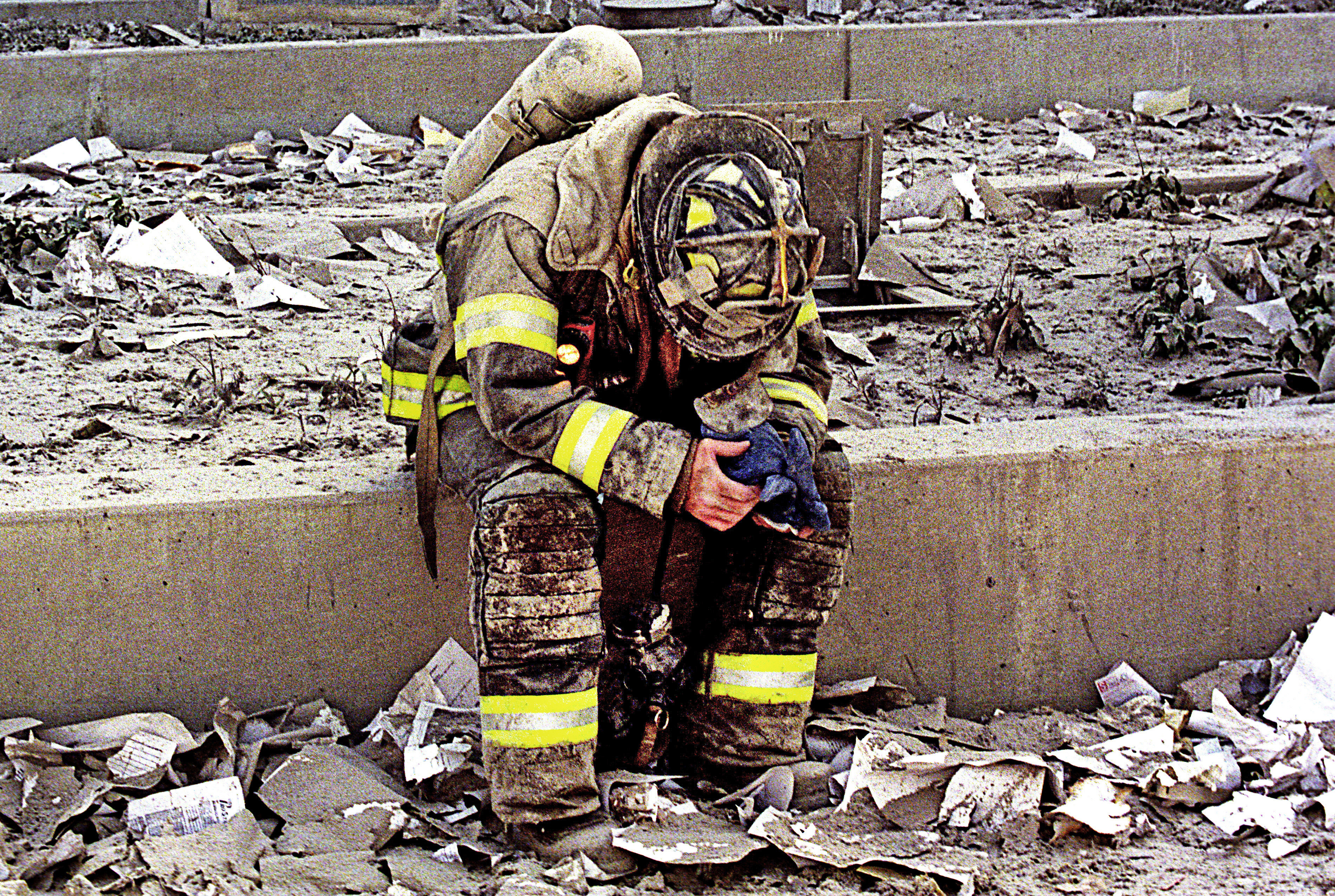
September 11, 2001
Escape
Rear Adm. Jeremiah Denton described his brutal seven years and seven months in North Vietnamese captivity in his book, "When Hell Was in Session." On the morning of Tuesday, Sept. 11, 2001, hell reconvened at New York’s World Trade Center. I was there.
I was attending the National Association for Business Economics annual conference at the Marriott World Trade Center hotel, situated at the base of and between the two 110-story towers.
My work had wrapped up Monday evening. We had contracted a video production crew and interviewed 16 senior economists for their views on the important role of the 2002 Economic Census in improving the quality of our national economic statistics.
Tuesday morning, I was taking my time preparing to check out and take a taxi to Penn Station to catch an 11 a.m. train back to Washington. I was about to step into the shower in my ninth-floor room at 8:46 a.m. when I heard the piercing sound of an accelerating jet aircraft. It instantly struck me that it was odd that a jet was flying that low over Manhattan. A split second later, I heard a thunderous explosion and the building shook.
My room faced the grand plaza of the World Trade Center complex. I rushed to the window and saw beams of steel raining on the plaza as if they were pieces of Styrofoam falling from the air. People were running for cover. I could not see above the 10th floor of either tower.
I sensed right away that I was in danger and quickly threw on a shirt and a pair of shorts, grabbing my wallet and cell phone. I opened the door and smelled jet fuel. I hurried toward the nearest emergency exit, but two guests I encountered said it was blocked by debris.
We found one stairwell that led to the lobby level, where a hotel employee directed us to the Tall Ships restaurant and lounge, where we exited onto Liberty Street to a scene of damaged vehicles with blown-out windshields; the street was littered with large pieces of debris.
"Don't look back," shouted a police officer. I couldn't. I was barefoot and trying to avoid the shards of glass. It was only when I reached what -- at that moment -- was relative safety across the street that I turned around and took in the true horror unfolding behind us.
The events that followed have been documented, but words can never fully describe the horrific scenes. I was just across West Street where other escapees had gathered. We heard another aircraft. Looking up, I could only see its black underbelly as the plane tilted, aiming to take out as many floors as possible. To me, it was not instantaneous. I saw the impact. Heard the crunching metal. The flash and explosion. Then, its thunder shook down. It was, as others described it, like watching a movie. Only it was real.
As flames in the buildings raged out of control, our shocked crowd instinctively started moving toward the water – the Hudson River. Then we heard the rumbling coming from the middle of the South Tower. Sensing all 110 stories would collapse on us, we began to run. It was collapsing downward, rather than toppling into us. However, the giant wall of grayish dust and smoke was moving down the canyons of Manhattan. We didn’t know what was in that cloud. We feared a firestorm of flying debris.
The cloud enveloped us in choking dust and smoke for what seemed like an eternity. I pulled my shirt over my head to breathe as we made our way to Battery Park. Shortly after we reached the park, the North Tower collapsed.
Amid the chaos, I found someone with a Marriott badge who was marshaling other employees and trying to account for those who were missing. My cell phone would not work, but he was able to call his wife. I gave her my wife’s phone number so she could tell my wife I had gotten out OK.
A flotilla of boats, ranging from ferries to police and Coast Guard vessels and a ship from the Army Corps of Engineers, docked to evacuate us. After stopping at two other piers in Manhattan to pick up other evacuees, we headed across the Hudson River. As we gazed back, the enormity of the tragedy began to sink in. We were lucky to be alive.
Across the Hudson
Homeward
In the middle of the river, I cringed at the sound of another jet aircraft. But when I looked up, it was a military F-15 patrolling the skies, which offered some assurance to this veteran of 27 years in the U.S. Air Force.
We docked at Jersey City, New Jersey, where paramedics taped towels around my bare feet. We were transported to the Newark train station, where more medical workers conducted triage. Two of the Marriott employees were loaded into an ambulance for further treatment at a hospital. Other Marriott employees took me to their hotel at Newark airport, which was in a security lockdown.
Not a moment passed without me thinking about my fellow Census Bureau employees and wondering whether they were safe. It was not until late Wednesday morning that I learned they had been knocked to the floor by the downward concussion from the first blast, escaped the hotel, and evacuated to Staten Island. Unaware of my status, they had rented a U-Haul truck to return to the Washington area.
With no ground transportation available to get me home, my good friend Mark Tolbert (a retired U.S. Army major) from the Public Information Office drove from Suitland, Maryland, to pick me up Wednesday evening and returned me to a grateful family.
On the way back, Mark told me about the deaths of two colleagues from our New York regional office.
A few days after my return, I was fortunate to have an exchange with Oklahoma City bombing survivor Richard Williams, who was assistant manager of the Alfred P. Murrah Federal Building. He had this advice:
"You must understand that you made no choices on that day. You were either fortunate to be alive or seconds and inches made a difference in your life. At this point, do not feel like the fact that you survived is not important because it is. Seek counseling, seek companionship from those who have experienced the same tragedy and feel similar to the way you feel right now.
"We in Oklahoma City became a unique fraternity, but not by choice. Due to the tragedy, we have been able to pull strength from each other during those most difficult days."
I will forever feel a special bond with those of us who found ourselves in the middle of what seemed like Armageddon.