Chapter Eleven
Broadening the Information Arena
Communications and Computer Systems
Like most public affairs officers and NCOs, I rarely gave the Communications function – how we transmitted voice, information and data -- much thought. The Army had its Signal Corps, we had our Comm squadrons. Comm guys provided the services we took for granted. Unless we had a disruption.
Computers? We had “mainframes” somewhere. They were responsible for those punch cards notifying us of immunization appointments.
I had begun my Air Force career in an Information office. I had listened, with a somewhat indifferent ear, to Professor Brooks Hill at Oklahoma University, when he cautioned the Air Force not to rename our function, “Public Affairs.” In ensuing years, however, I sensed the term “Information” had been usurped by the Air Force Communications functional area. Trade publications heralded the advent of business “Chief Information Officers” to shepherd the incorporation of computer and computer-based (or digital) communications into their organizational structures.
Bill Slick
I first heard about Bill Slick in Greenland in 1977. A huge carton had arrived at the post office. I figured it must have come from one of the first ships to arrive after our port waters had thawed. It contained volumes of forms, with instructions that we were to document each task we performed each hour of each day, for a two-week period. It was from Air Force Broadcasting in San Antonio and carried the signature of SMSgt William T. Slick, a manpower specialist who was developing manpower standards for Air Force-managed stations. I had been out of the Air Force Broadcasting system for several years and knew little about its new hierarchy. I also knew we were extremely busy and had no time to complete extra paperwork. I made a command decision: I placed the entire contents into the dumpster (recycling was not yet in vogue). And never heard another word about it.
Fast forward to my arrival at AFBS, SMSgt Slick had retired and, through manpower and personnel expertise, had transitioned into a civilian Resource Manager position at AFSINC. He had developed the manpower standards, and they were being applied in Air Force Broadcasting—and working. Any commander requesting AFRTS service, or changes in service, would know the cost of doing business. There was no more guesswork about how much manpower was needed to do the job, or for personnel specialists to levy assignments.
I got to know Bill through our staff meetings and interaction, never confessing my transgression of eight years earlier. Over the years, Bill had acquired responsibility for AFSINC’s logistics, budgeting, manpower and both military and civilian personnel functions, advancing to GM-15 status. AFSINC’s “support” functions were consolidated. AFNEWS operational directorates were freed to devote full attention to the business of writing, broadcasting and product development. Bill had also absorbed the responsibilities for Public Affairs wartime planning.
And Bill excelled at communication in his own realm. He demonstrated unparalleled understanding and vision of how communications and computer systems were transforming our operations. He dazzled the rest of AFNEWS, and I’m sure SAF/PA, by preparing his own overheads and using Lotus 123 for spreadsheets and Harvard Graphics for quick graphs and charts. There was no longer a need to wait hours or even days for a graphics section to produce overheads. He could prepare them almost instantly and in his office. More change was imminent.
Toward the end of 1989, Bill had wisely convinced the AFNEWS commander to place the fledgling Communications and evolving Small Computers functions under his directorate. The existing Comm officer and NCO had been notified of permanent change of station orders, and Bill had used his manpower and personnel acumen to create a C-CS division and identify the specific manpower positions needed. Several computer programmers, first-term airmen, were inbound straight out of tech school. No outdated communications or mainframe expertise would be needed. Would I be interested in becoming part of that effort?
I had spent five years at AFBS in both operations and as senior enlisted advisor. I managed teams. I knew staff work. I knew the nuts and bolts of public affairs and broadcasting. I was aware of the parochial interests and turf in the organization and how those long-held views impacted communications within the organization. Bill had also laid the groundwork for AFNEWS to become SAF/PA’s Executive Agency for communications and computer systems, owing to its lack of resources and manpower to perform that task.
I said I would think about it for a few days.
I had done everything I had set out to accomplish at AFBS. I had accompanied Col. Tilma to both overseas theaters. I was visiting the same locations for the third and fourth time. Up and coming senior NCOs were waiting in the wings. Col. Tilma would benefit from choosing his own advisor to complement his leadership style. The only overseas billets I desired were filled by volunteers, with others waiting. I would have gladly taken a position at a major command, but MAJCOMs didn’t know me or my background. I was a public affairs chief, but had operated primarily in broadcasting for nearly a decade.
I said “Yes!”
A New Shop
I moved into the main AFNEWS headquarters building in early January 1990. Kelly Air Force Base and Lackland were still abuzz with activity from the Panama invasion, which had reminded all of us that our mission was to fly and to fight.
We carved out cubicles on the second floor next to the Hometown News Center. We spent the first few weeks getting to know each other and doing a little team building. We mutually set our first goal: Study Hometown News Center operations and devise a plan to transition from the proprietary Datapoint system — tied to a mainframe and external printing — to perform all functions in-house.
Our programmers welcomed their first challenge and immediately began documenting all input and output processes. In a matter of only a few weeks, they developed programs and began testing them with great success. We ordered basic computers to replace the dumb terminals, along with precision laser printers.
I think that success exhilarated all of us. It proved that we were capable of great things.
We then focused on equipping workstations throughout the AFNEWS campus with personal computers and networking them through Ethernet wiring. Only one area remained “off limits” — the Apple Macintosh computers had already earned the devotion of staffers at Airman magazine.
Behind those immediate tasks was the primary reason I had accepted my new role at AFNEWS. As an arm of SAF/PA, AFNEWS needed to establish itself as the official voice of the United States Air Force in computer and communications services, including the emerging internet. Before we could reach that growing audience, however, we had to get our own offices connected.
Email communication had just been blessed by the Air Force as an official form of communication. Interoperability between SAF/PA and AFNEWS was the ideal, but not within easy reach. Our C-CS staff appeared to be the only people viewing that connectivity with a sense of urgency. Technology was racing ahead, with changes happening almost day to day instead of at six-month intervals. Dial-up telephone modems were the primary entry points for computer-to-computer connectivity, but the MILNET system was evolving, albeit with the speed of a snail. Radical change was underway.
Desert Shield
Our peacetime lull was interrupted in late summer 1990. Iraq invaded Kuwait, and the rumbles of war began. The Desert Shield buildup soon got our attention.
Our war planners went into full motion, putting together a combat action team for Air Force public affairs to deploy and cover activities by our deployed Army, Air Force and Navy forces. Our AFBS war-planning people were mobilizing equipment and resources to keep our forces informed as they began to pour into the theater.
Communications and computer systems took on a new urgency.
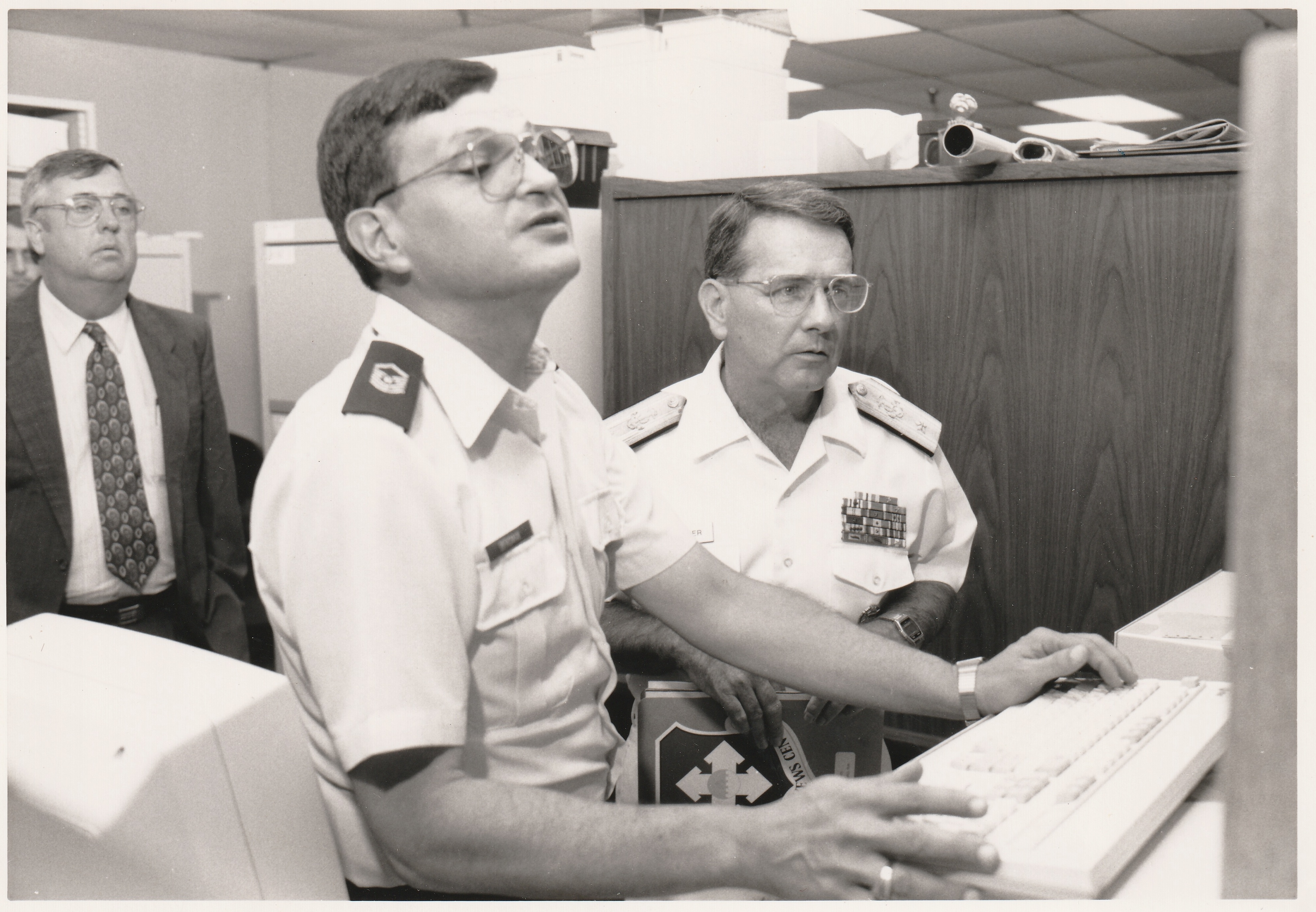
It was our responsibility to equip a public affairs combat action team. MSgt. Chuck Ross traveled to Houston and consulted oil companies to identify laptops and portable printers for use in the desert. We acquired an AT&T 3B2, a Unix-based host and a new Air Force standard. It would become our communications hub.
The AFNEWS-generated combat action teams paid dividends for Air Force public affairs. They demonstrated the effectiveness of our wartime planning team and our C-CS staff. We deployed one of our programmers with the team.
Tap the photograph to examine it at full size.
Initial Networking
Meanwhile, audiences outside our offices were growing.
Computer online services and bulletin board systems were expanding. Sales of PCs were skyrocketing. Anyone with a computer and a modem was now a publisher. Few rules. The sky was the limit.
The purpose of our connectivity efforts had become apparent when Dan Doherty, a staffer at Air Force Reserve headquarters at Robins Air Force Base, Georgia, began pushing AP wire-service stories and other news products through a system he had gained access to in New Jersey called tecnet. AFNEWS needed to be at the origin of information pipelines. We joined the fray.
I began posting our AFNEWS products, along with selected products available through our system, which we christened the Air Force Public Affairs Network, or AFPAN. I also created Air Force official accounts on popular commercial services: America Online, Prodigy and CompuServe, placing products in communities there. I added distribution to military forums on USENET – the loosely structured and ungoverned forerunner of today’s social networks. Computer-based communications escaped traditional molds. Access to the world was no longer restricted to military operations and academia. At some point, I opened sign-ups for people to receive Air Force products by email.
Air Force news should come from an af.mil address.
The Hotline
Only hours before the first airstrikes of the war, we received an urgent request to set up a 1-800 hotline.
My staff excelled.
Regina Gonzalez took the telecommunications lead and nurtured a Herculean effort. Our people set up and networked workstations, with programmers working 24 hours a day to acquire and update the databases we made available to telephone operators.
Our team won well-deserved recognition.
I did not enter my own recognition into my official military personnel records. I didn’t think chief master sergeants should be considered for achievement medals.
A Plan of Our Own
I am unclear about the dates, but in the ensuing months it became apparent that Regina could handle the day-to-day management of computer operations and the programming staff. I transitioned into a full-time role as the SAF/PA executive agent for communications-computer systems.
I was still moving our products around the world, but my initial focus in that role was developing a Communications and Computer Systems Plan for the Air Force Public Affairs functional area.
I attended meetings throughout the United States of a C-CS working group with representatives of major commands and functional areas. The post-Desert Storm lessons had revealed serious shortcomings in how our communications and computer systems worked together. Systems that served one organization well could become obstacles when information had to cross into another.
Air tasking orders could not always be transmitted electronically to some combatants. Aircraft were airborne with little or no communications infrastructure waiting at their destinations. Hours of airstrike video and combat camera products could not readily be processed and transmitted.
Despite — or perhaps because of — increasingly advanced technology, the system could still snarl when it came to getting information to the people who needed it. That was the larger military setting for the work I was taking on. It became the focus of my work on the Communications and Computer Systems Plan for Air Force Public Affairs. Our offices needed to exchange information reliably and steer their own avenues on this new “information highway.” Equipment, software, connections and training all had to be considered together.
I do not know the date we published and distributed the plan, and regrettably I did not grab a copy for my personal archives. I had long abandoned the practice of saving everything with my byline and accepted that individual pride in ownership yielded to total team ownership.
But I know the plan went to the major commands, agencies and functional areas and, of course, Headquarters Air Force.
After publication, I was summoned to brief Maj. Gen. Al Edmonds at the Pentagon. His staff had read the plan and provided several questions, which I answered.
His directions were clear: Proceed with the integration plan, using Air Force standard systems.
He asked me about the nonstandard equipment we had encountered, and I tried to explain that the Macintosh computers were unique requirements for publishing the Air Force’s flagship magazine, Airman. I also touched on the off-the-shelf solutions we had found to equip our combat action teams.
And I took advantage of the session to emphasize the need for a fiber-optic node to the af.mil data network to handle the bandwidth required for audiovisual products at AFNEWS.
I do not know who did and did not read our plan. We did have public affairs officers visit over several months to discuss topics outlined in it. Representatives of both the Army and Navy dropped by, and I was asked by OASD/PA to join its working group to advance a coordinated approach throughout Department of Defense public affairs activities.
Last Duty as a Narrator
My last duty as a narrator came at the dedication of the new AFNEWS headquarters building on East Kelly, featuring Air Force Secretary Sheila Widnall and a host of distinguished visitors. In between announcements and introductions, I disappeared behind the colonnade. I was not asked to be in any photographs that day. My old, sports adage applied: The best officials are those who you don’t recognize as being there.
Moving On
Time and progress continued to march on, and my primary objectives had largely been met.
It was time for me to move on.
Col. Ted Tilma, by then the commander of AFNEWS — selective early retirement boards had not been kind to AFNEWS officers — had indicated to the Chief’s Group at the military personnel center that I was ready for a new assignment.
And the call came.
It was the vice commandant of DINFOS, an Air Force officer whom I recognized as having served primarily in the audiovisual field. I was invited to return to the schoolhouse in Indianapolis, with a follow-on to Fort Meade, Maryland, and help establish the computer and communications systems infrastructure there.
I was intrigued by the opportunity and given a few days to think about it.
After conferring with friends at DINFOS and consulting my spouse, I respectfully declined.
The assignment meant working with hardware, organizing installation crews, laying cable and putting together the new infrastructure. I did not feel qualified to do that.
I had been fortunate to be placed in a position at AFNEWS with the right executive oversight, the right teammates and the right support staff and equipment. They made me look good.
But I was just a coach and a cheerleader.
They were the hard workers.
The performers.
That decision started the clock ticking toward my retirement.
Beyond Internal Information
I spent the final months expanding my media distribution system, staving off objections from some senior staff in the internal information area who argued that we had a contractual obligation to let base newspapers print Air Force News Service products first.
I later found it ironic that advances in communications and computer systems prompted the Air Force to abandon base newspapers altogether some years later.
I loved base newspapers, especially the Fighter Forum, and the fine military journalism we exhibited. And I loved internal information, public information and Information itself — however you wanted to define it in the new 24-hour news cycle.
But it was time to move on.
Those activities continued until my retirement ceremony in early December 1994. My retirement date would be March 1.
From the Record
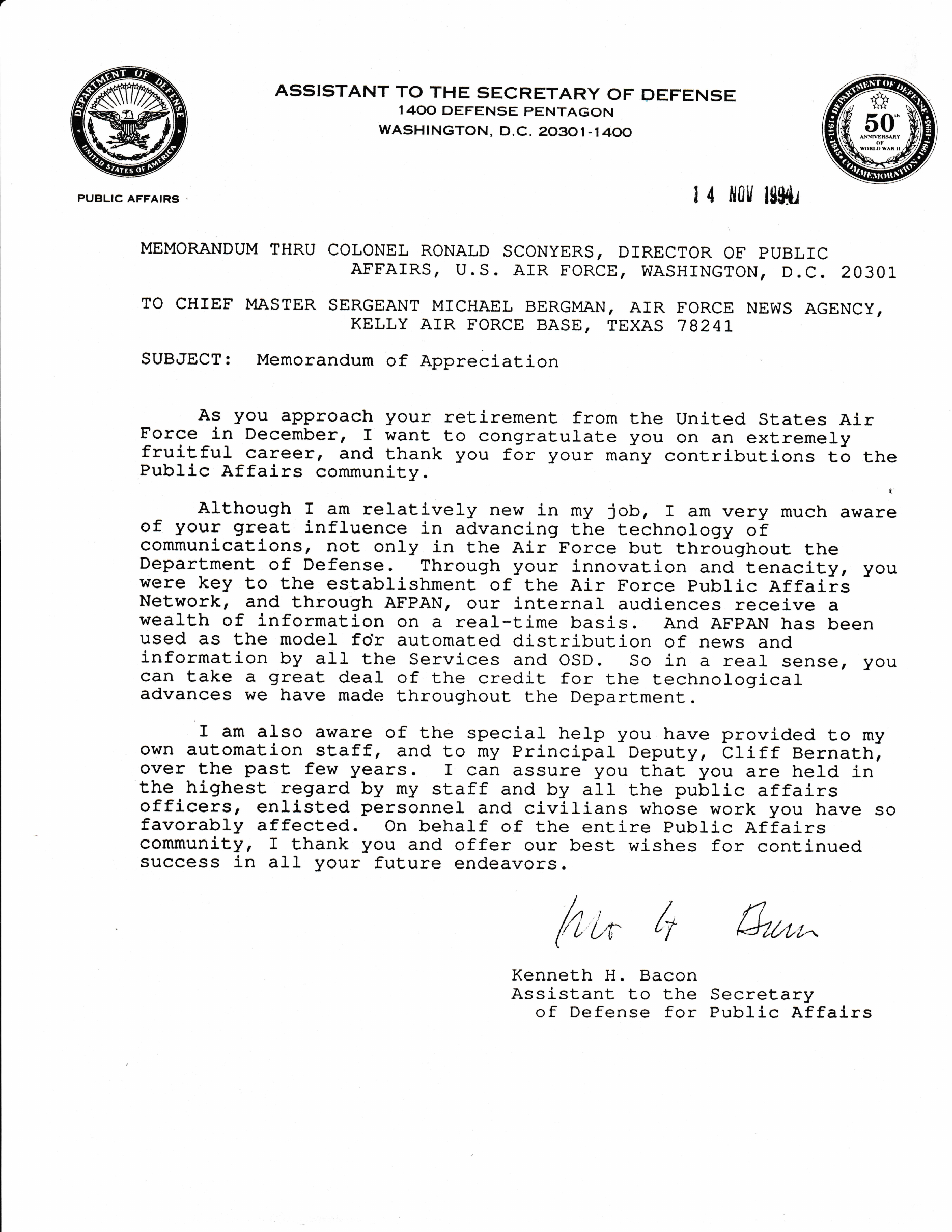
Memorandum of Appreciation
Tap the memorandum to examine it at full size.
Kenneth H. Bacon, Assistant to the Secretary of Defense for Public Affairs, memorandum of appreciation, Nov. 14, 1994. Reproduced in full from the source copy.
The Reach of the Work
Beyond Internal Information
We were operating beyond the scope of internal information and broadening the information arena for Air Force Public Affairs.
“Thanks for all the help and encouragement you gave me as we developed Military City Online.”
Lee Ewing
Military City Online on AOL
Nov. 29, 1994
“Mike -- and thanks to you for providing a valuable service and responding to questions quickly and with a lot of pertinent info.”
Bob Brewin
Federal Computer Week
Dec. 1, 1994
“Good Luck! and congratulations on a job done exceedingly well. You deserve the very best for the tremendous services you have provided.”
LCARTER
Library of Congress
Farewell message, Nov. 29, 1994
(full name not confirmed)
About a month before my retirement ceremony, I advised my worldwide distribution lists of my pending departure.
There was no continuity plan.
I had pretty much operated independently in cultivating this new audience that was difficult to put into any one category: Air Force retirees in education and industry; people in think tanks; ROTC units; Air Force officers in embassies; students; Air Force parents. The list went on.
In my message, I cautioned that I was unsure whether the service to them would continue, and I solicited replies.
I got 204 responses.
I printed some of them, filling 38 pages in a loose-leaf notebook. I passed the notebook on to Master Sgt. Lee Wayman in Internal Information.
And retired.
That was pretty much the last I heard from AFNEWS.
Hopefully, I made a footnote in AFNEWS history.